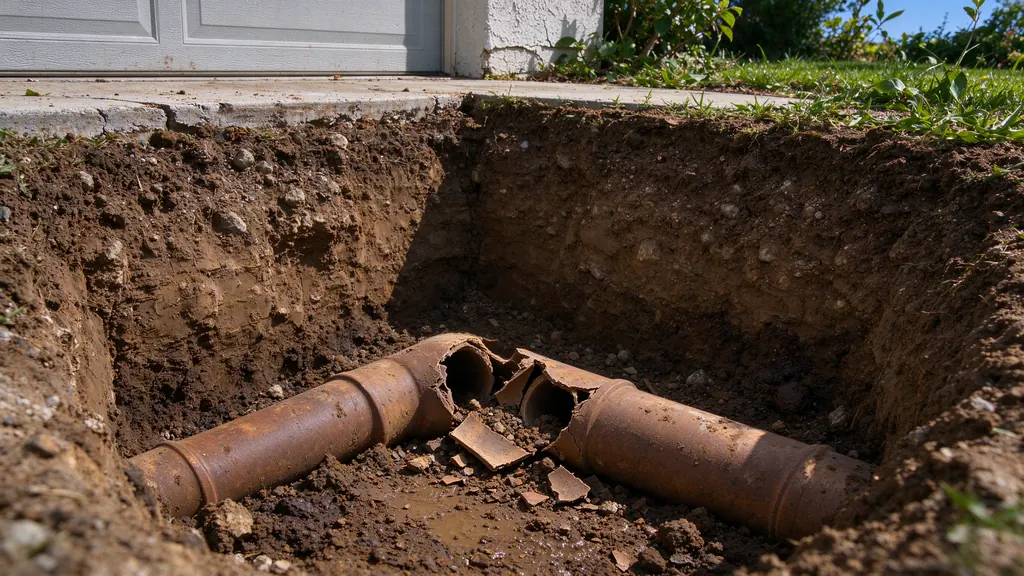
Last updated:
Collapsed sewer line repair starts by confirming that the pipe has actually lost its shape, finding exactly where, and then replacing that section, or the whole lateral if more of it has failed. A collapsed section cannot be lined, so the repair is excavation or a full replacement. Angeleno Sewer Line Repair handles collapsed laterals across Los Angeles, Pasadena, Glendale and Burbank, and the work begins with locating the failure before anyone digs.
The word “collapsed” gets used loosely. A line that keeps backing up is not necessarily collapsed, and a camera that cannot get past a point has found an obstruction, not yet a diagnosis. The difference matters, because a true collapse means digging, and a root mass or a debris plug does not.
Signs that point toward a collapse
No single symptom proves it, but some patterns make collapse more likely than an ordinary clog:
- The line blocks completely, and clearing either fails or buys only a short reprieve before it blocks again.
- The cable or jetter stops at the same distance every time, and comes back with soil, gravel or pieces of pipe rather than roots and paper.
- A depression, sinkhole or persistently wet patch appears in the yard or driveway along the line’s route, at about the distance where the tools stop.
- Sewage odor outdoors at that spot, or water surfacing there when fixtures run.
- Drains throughout the house fail together, which points to the shared line rather than one fixture.
Several of these also fit a severe root intrusion, an offset joint with a lip that catches everything, or a buildup of grease and debris. That is why a recurring clog alone is not grounds for a collapse diagnosis. Our guide to the signs of a broken sewer line goes through the overlap.
Diagnosing a collapse when the camera cannot pass
The camera is the main tool, but a collapse is exactly the defect that stops it. Getting a reliable answer takes a few steps.
Clear what can be cleared. A jetter or cutter is run to the obstruction to remove roots, grease and loose debris in front of it. If the line opens up and the camera passes, the problem may have been a blockage after all, and the footage will show what caused it. Pushing hard against a true collapse can make it worse, so the operator watches what comes back.
Film the stopping point. Even if the camera cannot pass, it can usually see what stopped it. Soil filling the pipe, the crown of the pipe pushed down, fractured pieces lying in the invert or a section that has visibly lost its round shape are collapse findings. A wall of roots or a sharp offset is something else.
Locate it from above. The camera head carries a transmitter that a locator reads from the surface, giving the stopping point’s position and depth. That spot is marked on the ground, and its depth decides how the dig is planned and whether shoring is needed.
Look from the other side. If there is a cleanout near the property line, or an access point can be opened downstream, the camera can come in from the other direction and show how long the failed section is. Without that, the true length of the collapse is often only known once the pit is open. A camera inspection report should say plainly whether the far side of the collapse was seen.
Check for other utilities. Before excavating, underground utilities are marked. If there is any reason to suspect a gas or other utility line has been bored through the sewer, nobody should run a cutter at that point until the utility has been contacted, because cutting into a gas line inside a sewer is dangerous.
What causes a sewer line to collapse
Material failure. Old clay, cast iron and other materials weaken over time. Cast iron can corrode until the bottom of the pipe is gone and the remaining wall gives way. Fiber and cement pipe can deform under soil load.
Crush loads. Pipe that was laid shallow can be crushed by vehicles, heavy equipment or a new driveway, slab or structure built over it without allowing for the load.
Soil movement. Settlement, washed-out bedding from a long-term leak, clay soils that swell and shrink, and earthquake ground displacement can all break rigid pipe.
Roots. Roots that have entered a joint and thickened for years can split the pipe and let soil in, which is how many partial collapses begin.
Construction and utility work. Excavation for a pool, foundation, retaining wall or neighbor’s project can hit a lateral. So can utility work in the street or parkway, including directional boring, which drills underground and can pass through a sewer line it did not know was there.
When construction or a utility damaged the line
If the damage followed nearby work, documentation matters more than speed of accusation. Useful records include:
- Dated camera video showing the damage and the footage counter, and earlier video of the same line if you have it.
- Photos of the work site: paint and flag markings on the ground, signs on equipment or barricades naming the company, and the excavation or bore location relative to your line.
- The dates the work took place and when your symptoms began.
- A written description of the defect from the contractor who repairs it, and any broken pipe pieces removed during the repair, kept if practical.
With that in hand, the claim goes to the utility or contractor responsible, and possibly to your insurer. Whether anyone pays depends on the facts and on how the claim is reviewed, and no one can promise the result. Keep the line in service safely while the claim is pending; you do not have to leave a backing-up sewer unrepaired to preserve evidence if it has been documented well. The insurance guide covers what policies typically exclude.
Repair options
Spot repair. When the collapse is a single section in an otherwise sound line, a pit is dug at the located spot, the broken pipe is removed and new pipe is joined to the existing line with listed transition couplings. This is the most common collapse repair. See spot repair.
Full replacement. When the camera shows the rest of the line is also failing, or there are several collapsed sections, replacing the lateral makes more sense than chasing failures. That can be done by open-trench excavation, which also corrects grade.
Pipe bursting. Bursting can sometimes pull new pipe through a line with a partial collapse, because the head breaks the old pipe as it goes, but a section filled with soil or badly displaced may need to be dug out first.
Lining. Not through the collapsed section. After the collapse is dug out and replaced, the remaining sound pipe can sometimes be lined if it has other defects.
Excavation to a collapsed lateral is often deep. Trenches 5 feet or deeper need shoring or another protective system under Cal/OSHA and federal OSHA rules, and a collapse in loose soil is exactly where an unprotected trench is most dangerous.
How urgent is it?
If sewage is coming up into the house, the first steps are to stop running water, keep people away from the affected area and get help; the emergency sewer repair page and the sewer backup guide cover what to do in the first hour. If several neighbors are backing up, or sewage is coming out of a manhole in the street, the problem may be in the City main, and LA Sanitation’s 24-hour line is 1-800-773-2489.
If the line is still draining, even slowly, there is usually time to film, locate and permit the repair properly. A collapse rarely improves, so it should not wait months, but a measured day or two to confirm the location is far cheaper than a pit dug in the wrong place.
Permits and the street section
Private-side repairs in the City of Los Angeles need an LADBS plumbing permit and inspection. If the collapse is in the lower lateral under the street, the repair needs a Bureau of Engineering S-Permit issued to a City Bonded Sewer Contractor. The City grades lateral camera footage, and a Very Poor rating, which covers collapse, means repair is required.
What collapse repair costs
A collapse is priced as a spot repair or a replacement, depending on how much of the line has failed. Typical budgeting ranges for Los Angeles-area projects, as of October 2026: one failed section on private property runs $1,500–$8,000, pipe bursting $6,000–$25,000 per job, and full open-trench replacement $5,000 to $25,000 or more. Depth, what sits above the pipe and whether the street is involved push a job up its range. These are budgeting figures, not quotes.
Who does the work
Collapse repairs are performed by licensed, bonded and insured contractor partners. Any repair of the lower lateral in the public right-of-way is done by a City of Los Angeles Bonded Sewer Contractor under the S-Permit.
What the work includes
- Clearing what can safely be cleared so the camera reaches the obstruction
- Camera inspection with the stopping point measured and located from the surface, including depth
- A second look from another access point where one exists or can be added
- Dated video and photos of the defect and the surface above it, kept for any claim
- Excavation and replacement of the failed section, or replacement of the line by trench or bursting
- Temporary measures to limit water use while the line is out of service
- City inspection and a post-repair video of the full line
Have a camera report, or a line that keeps backing up?
Phones answered 24/7, every day. Bring the video if you have one.
Related resources
Representative jobsite views
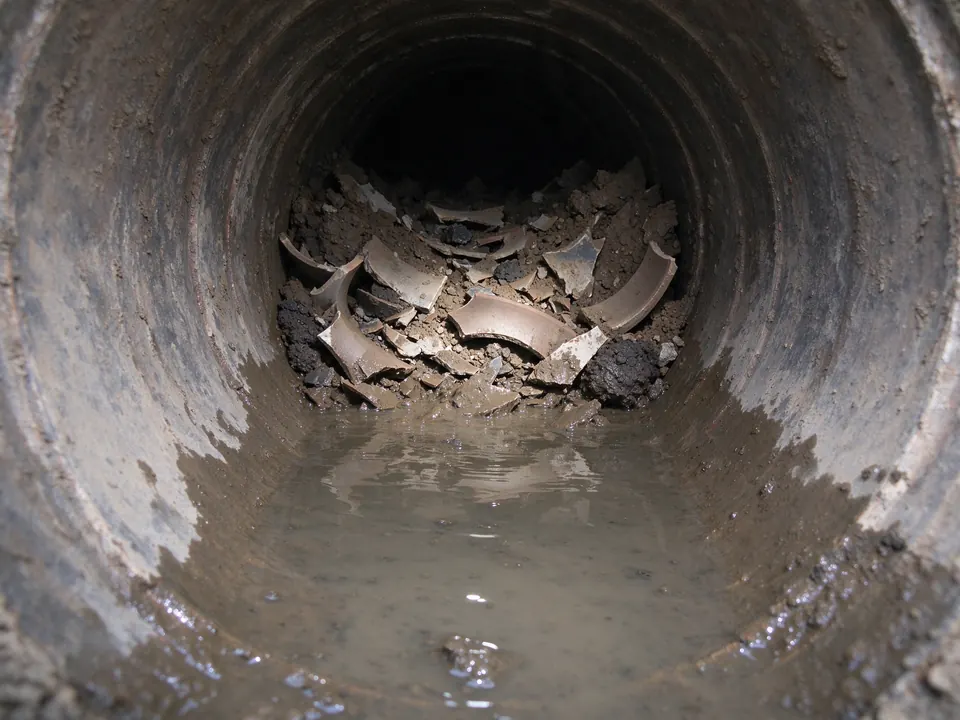
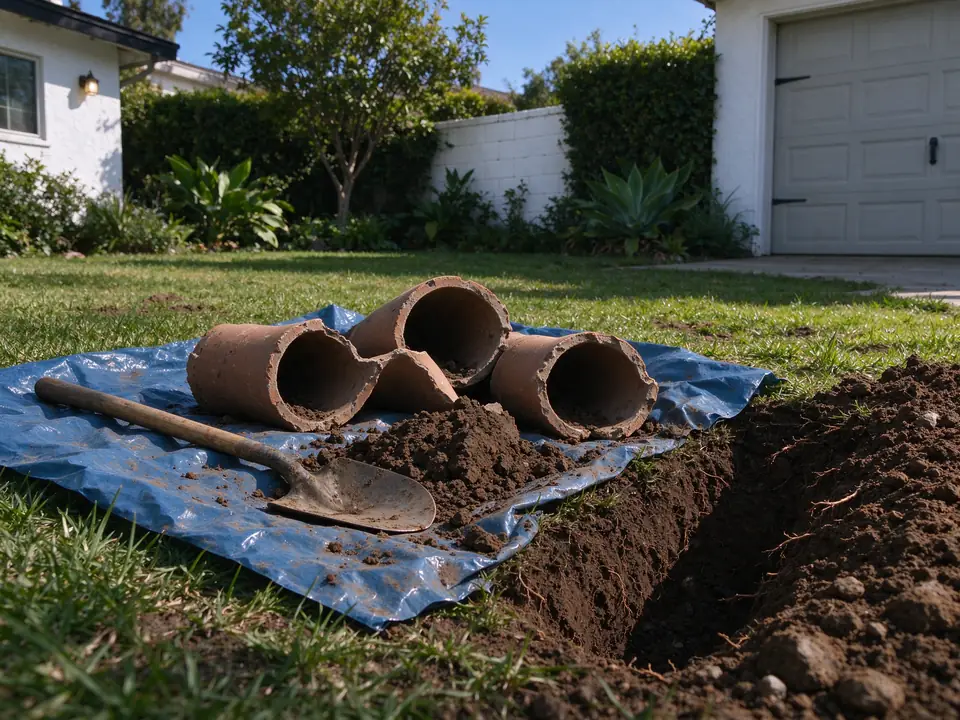
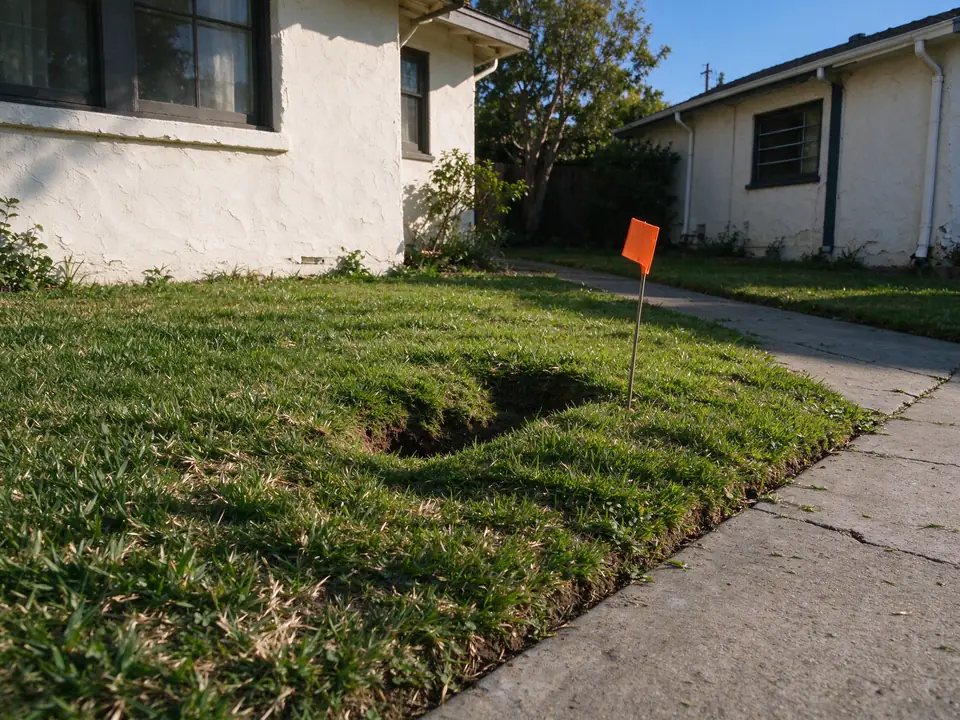
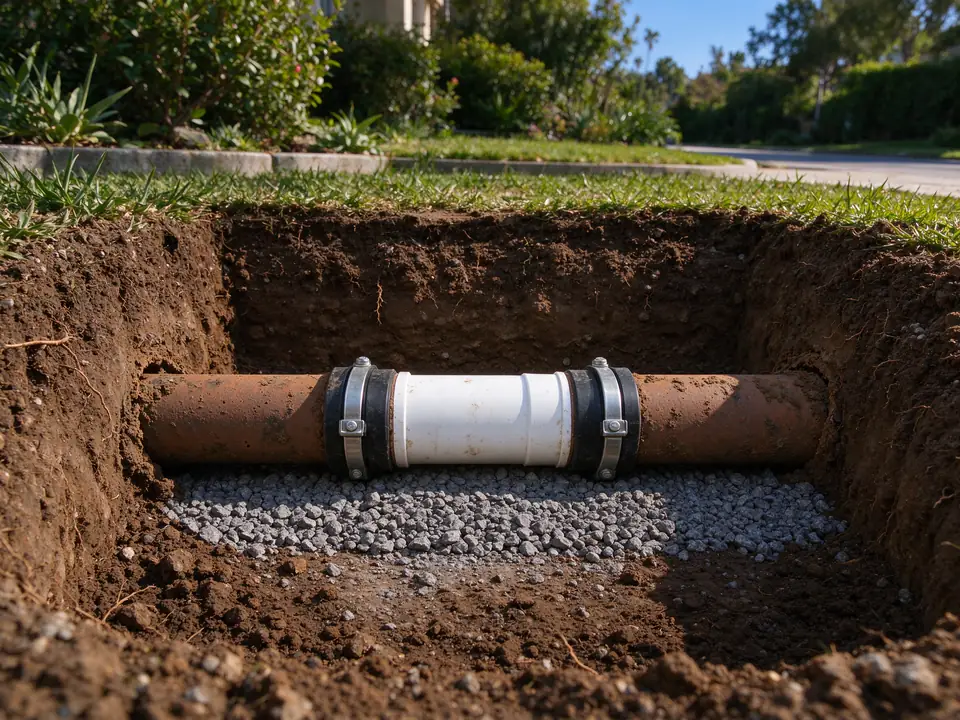
Representative illustrations of this kind of work, not photos of a specific job.
Questions people ask
How do I know if my sewer line has collapsed?
The usual pattern is a line that blocks completely, clears briefly or not at all, and blocks again at the same distance. Soil or broken pipe on camera at that point, or a depression in the ground above it, makes collapse more likely. A dense root mass or a severe offset can look similar until the camera gets a clear view.
Can a collapsed sewer line be lined?
Not through the collapsed section. A liner needs an open pipe to form inside, and a collapsed section has lost its shape. If the rest of the line is sound, the collapsed part can be dug out and replaced, and in some cases the remaining sound pipe can then be lined.
A utility crew was digging near my line. Will they pay for the damage?
That depends on the facts, the utility or contractor involved, and how the claim is handled; nobody can promise an outcome. What helps is documentation: dated camera video, photos of the work site and its markings, the date the work happened, and a written description of the damage from whoever repairs it.
Is a collapsed sewer line an emergency?
It is urgent when sewage is backing up into the house or onto the ground, and the right move is to stop using water and call. If the line is still draining slowly, it is serious but usually allows time to film, locate and get the repair permitted properly instead of digging in the dark.
Does homeowners insurance cover a collapsed sewer line?
Policies vary. Many exclude wear, deterioration, settling and root damage, which describe many collapses. Damage caused suddenly by a third party may be handled differently, and some policies have service line endorsements. Read your own policy and ask your insurer before the work starts.