Last updated:
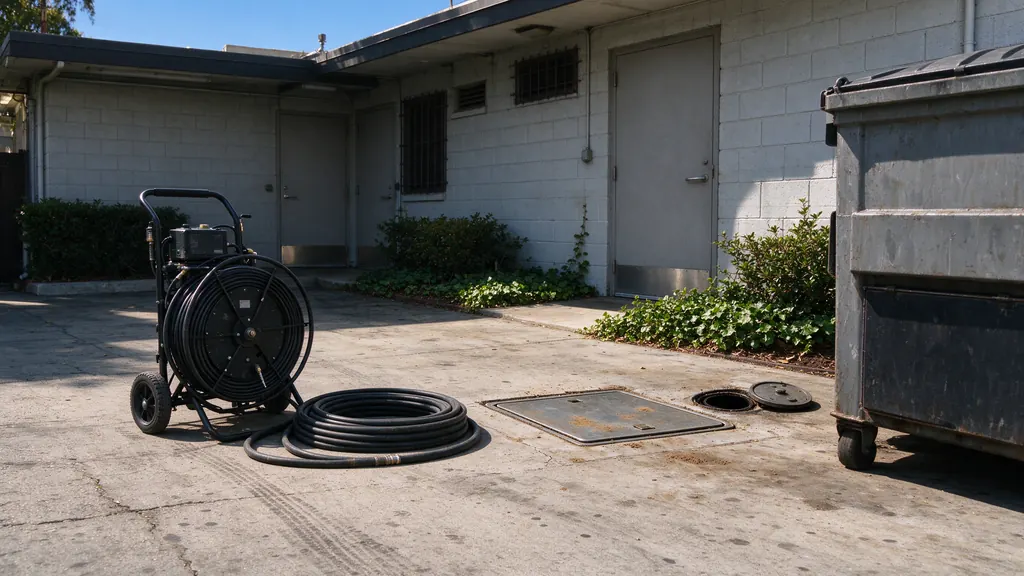
Commercial sewer line repair in Los Angeles covers the laterals behind restaurants, apartment buildings, mixed-use blocks and storefronts, and the main difference from a house is not the pipe. It is everything attached to it: residents who need water, kitchens that send grease down the line, parking lots over the route, and a frontage on a busy street. Angeleno Sewer Line Repair handles commercial laterals across Los Angeles, Pasadena, Glendale and Burbank, with the work planned around the people who use the building.
The City’s rule on ownership does not change for commercial property. The owner of the lot is responsible for the lateral from the building to the main in the street, including the lower lateral under the pavement. A lease or an association’s documents may decide who pays, but the City deals with the owner.
Restaurants, grease and the lateral
Fats, oils and grease are liquid when they leave a kitchen and solid a few feet later. They coat the pipe wall, narrow it, and catch food solids until the line stops. LA Sanitation attributes more than half of sewer backups in the City to grease and tree roots, and kitchens are where the grease load is heaviest.
The City regulates this directly. LA Sanitation runs a FOG Control Program under LAMC 64.30 as part of its industrial wastewater program. Under it, food service establishments that discharge grease must obtain an industrial wastewater permit and follow best management practices. Garbage grinders are prohibited unless specifically allowed. An establishment known to cause grease-related spills, or one that fails to follow the practices, can be required to install a grease interceptor or grease trap, and new food service construction, along with remodels of existing establishments valued at $100,000 or more, must include a grease interceptor.
That program sets the context for the sewer work. Jetting a grease-bound lateral restores flow (see hydro jetting vs sewer repair), but it does not change what goes down the drain, and a lateral cleared on Monday can be narrowing again within weeks. The useful sequence is to jet, film the cleaned pipe, and then separate two questions: is the pipe itself damaged, and is the grease load being controlled upstream? A camera that shows sound pipe under the grease points to cleaning frequency and kitchen practice. One that shows cracked or sagging pipe points to a repair, and a sag in a grease line is especially bad because it holds the cooled grease in one place.
Interceptor maintenance and pumping are their own trade, and the permit conditions for an interceptor sit with the operator. What a sewer contractor can add is evidence: where in the line the grease is accumulating, and whether the interceptor connection and the lateral downstream of it are intact.
Multi-unit buildings and occupancy
An apartment building or condominium cannot stop using water for a day without planning, and residents cannot be expected to know which hours matter unless someone tells them. The repair has to be scheduled so the line is out of service for as short a window as possible, with written notice to occupants saying when not to run water and for how long.
Method choice affects that window. Lining and pipe bursting typically take the line out of service for less time than a full trench, because most of the work happens before the old pipe is disconnected. They have their limits on commercial lines as on residential ones: a liner follows the shape of the host pipe and will not correct a sag, and a collapsed section has to be excavated or burst. On larger jobs, temporary bypass pumping can keep a building on sewer while a section is replaced. See trenchless sewer repair for how each method works and where it does not.
Multi-unit buildings also tend to have more than one access point and more than one branch joining the lateral before it leaves the lot. A camera inspection on a commercial property should map those branches, note which units drain to which line, and locate where the lateral crosses the property line.
Larger diameters and longer runs
The City’s standard house connection is 6 inches, existing laterals can be 4 inches, and commercial and multi-unit laterals can be larger, and the City decides connection size for some developments. When a house connection is too large for a standard wye on the main, the Bureau of Engineering can require a maintenance hole on the main instead, which is a much larger job in the street.
Size changes the equipment and the method. A 6- or 8-inch line needs bigger jetting nozzles and cameras that can light and center in a wider pipe. Liners and bursting heads are made for specific diameters, and upsizing a line by bursting has to be checked against what the City connection allows. Long runs under parking lots also mean deeper excavations at the low end. Trenches 5 feet and deeper need shoring or another protective system under Cal/OSHA and federal OSHA rules, and a parking lot trench usually has to stay open around vehicles and pedestrians.
Shared laterals and lot rules
Commercial and multi-unit properties raise questions about sharing that houses rarely do. In the City of Los Angeles, LAMC 64.11.1 states that not more than one lot shall be connected to any one house connection sewer. The Bureau of Engineering allows narrow exceptions. Where a lot that already used one connection for several structures has been split, the City Engineer may allow the original connection to keep serving more than one lot, provided four or fewer sewered structures are involved, no other connection is practical, the shared lateral has been inspected by CCTV, and every owner signs and records a Shared House Connection Sewer Agreement making them mutually responsible for its maintenance and repair. Small lot subdivisions have a separate exception tied to a recorded homeowners association or maintenance agreement. A property that reaches the sewer through a private easement may cross only one neighboring lot, and the private lateral in the easement is permitted and inspected by LADBS.
For an owner, that means two things. If a shared lateral fails, the recorded agreement, not a handshake, decides who pays. And if a project would add a lot to an existing connection, the City has to approve it before anyone builds on that assumption. The responsibility guide covers how ownership splits in more detail.
Street work at commercial frontages
Many commercial laterals meet the main under a busy street. The rules are the same as for a house: work in the right-of-way needs a Bureau of Engineering S-Permit issued to a City Bonded Sewer Contractor. The practical difference is the street. BOE permits follow City peak hour restrictions, which limit when lanes on many streets can be closed, and traffic control has to be planned for the lane or the sidewalk being occupied.
Street restoration costs follow the street, too. The City’s Street Damage Restoration Fee is charged per square foot of pavement cut, based on how the street is classified and how recently it was resurfaced; under the current schedule it is $8.24 per square foot on a local street and $19.44 on a select street, and commercial frontages are more often on select streets. Those figures are City fees, separate from the construction, and the sewer permit guide explains how they are assessed. The lateral repair under the street page explains the S-Permit process in full.
Documentation owners and boards can use
Commercial sewer work usually answers to someone besides the person who signs the contract: a property manager, an association board, a lender, an insurer, or a buyer’s due diligence team. The paperwork should be built for that. Useful records include before and after video with the address and date at the start, a written report with defects by footage, located positions and depths, the permit numbers and final inspection sign-offs on both sides of the property line, and a description of what was replaced and by which method. For City of LA ratepayers, the same records support LA Sanitation’s rebates, which are open to commercial and industrial owners as well as residential ones.
What commercial work costs
Commercial jobs are scoped from the camera footage and the site, and the residential budgeting ranges used elsewhere on this site do not transfer neatly to them. For orientation only, typical budgeting ranges for Los Angeles-area projects as of October 2026 put a residential camera inspection at $175–$800 and a hydro jetting visit at $300–$800; larger diameters, multiple access points and grease loads push commercial work above those. A written bid should state the diameter and footage, the method, the service interruption, after-hours work if any, traffic control and the permits it covers. Our guide to comparing sewer repair quotes lists what to check.
Commercial work is performed by licensed, bonded and insured contractor partners, and work in the public right-of-way by a City of Los Angeles Bonded Sewer Contractor under an S-Permit. Phones are answered 24/7 for buildings that back up outside business hours.
What the work includes
- Camera inspection of the lateral, with the building drain and any interceptor connection noted separately
- Clearing and jetting to restore flow, with grease and root findings recorded on video
- A repair scope that states service interruption windows and how occupants are notified
- Method selection for larger-diameter laterals and long runs under parking and hardscape
- Permits on both sides of the property line, including the S-Permit and traffic control for street work
- Before and after video, permit finals and located depths, organized for owners, managers and boards
Have a camera report, or a line that keeps backing up?
Phones answered 24/7, every day. Bring the video if you have one.
Related resources
Representative jobsite views
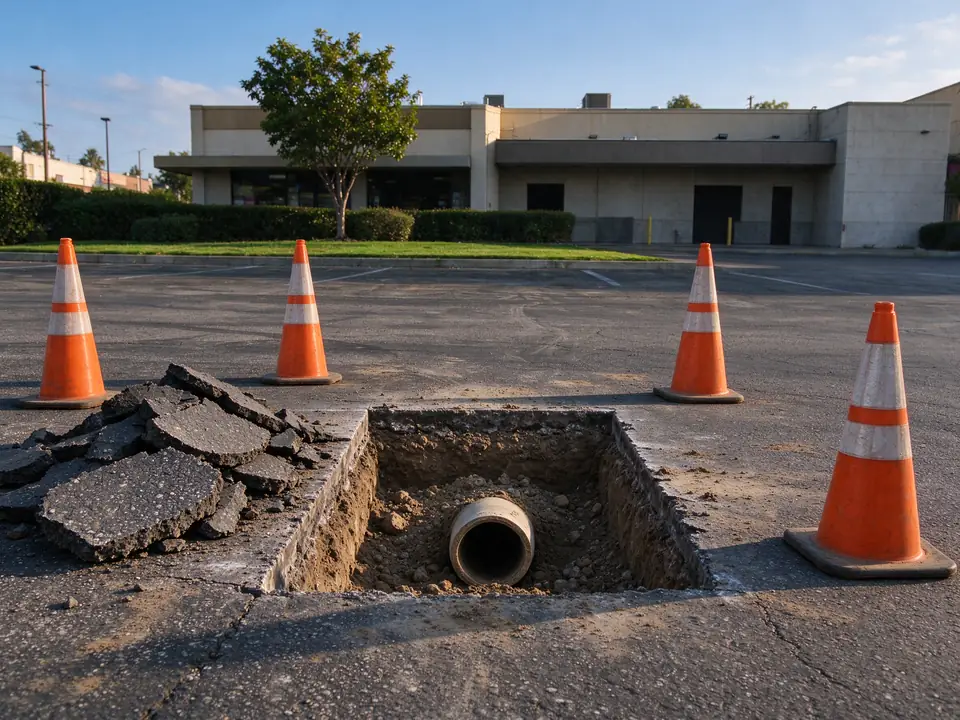
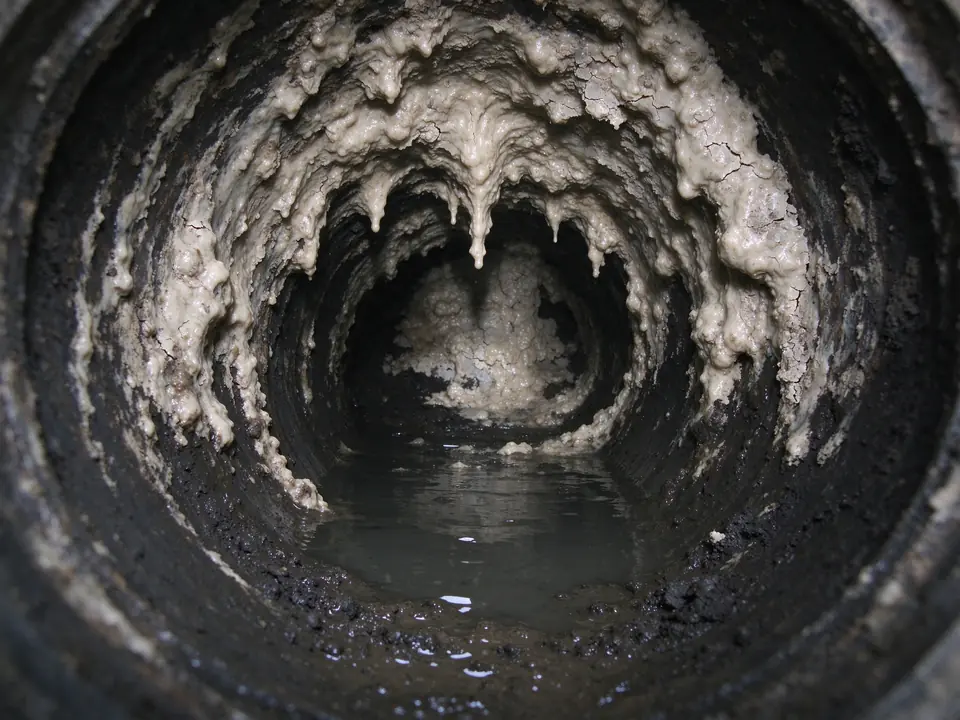
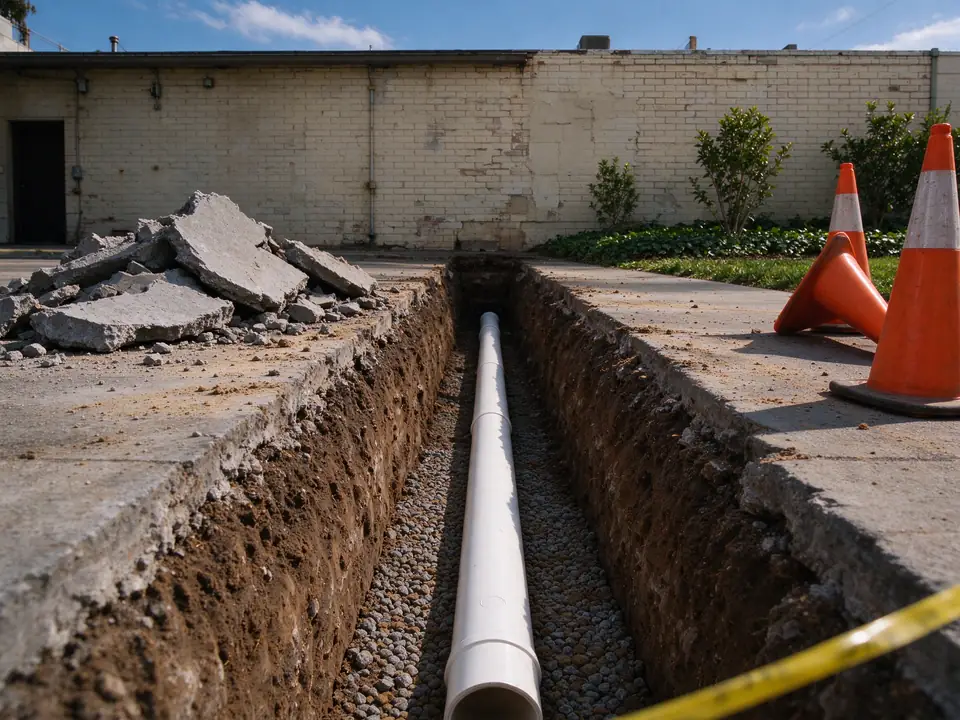
Representative illustrations of this kind of work, not photos of a specific job.
Questions people ask
Who is responsible for the sewer lateral of a commercial building in Los Angeles?
The property owner, for the whole lateral from the building to the City main, as with a house. A lease can shift maintenance costs to a lessee, and an association's governing documents can assign them among owners, but the City looks to the owner of the lot. Shared laterals carry their own recorded maintenance agreements.
Does a restaurant's grease problem mean the lateral needs replacing?
Not necessarily. Grease buildup is a cleaning and source-control problem first: kitchen practices, a working grease interceptor and regular jetting. The camera, after cleaning, shows whether the pipe underneath is also damaged. Replacing a lateral does not stop grease from coating the new one.
Can sewer repairs on an occupied apartment building be done without moving residents out?
Usually, with planning. The service interruption is typically limited to the hours when the old line is disconnected and the new one connected, and trenchless methods can shorten that. Residents need written notice of when not to use water, and the bid should state how long each interruption will last.
Can two buildings share one sewer lateral in Los Angeles?
Generally not. LAMC 64.11.1 says not more than one lot shall be connected to any one house connection sewer, with narrow exceptions for certain lot splits and small lot subdivisions that require City approval and recorded agreements. Within one lot, several buildings can share a lateral.
Do LA Sanitation's sewer rebates apply to commercial property?
LA Sanitation says its CCTV rebate, up to $300, and repair rebate, up to $2,500, are open to owners of residential, multifamily, commercial and industrial property who pay the City sewer service charge. Both are first come, first served while annual funds last and come with documentation requirements.