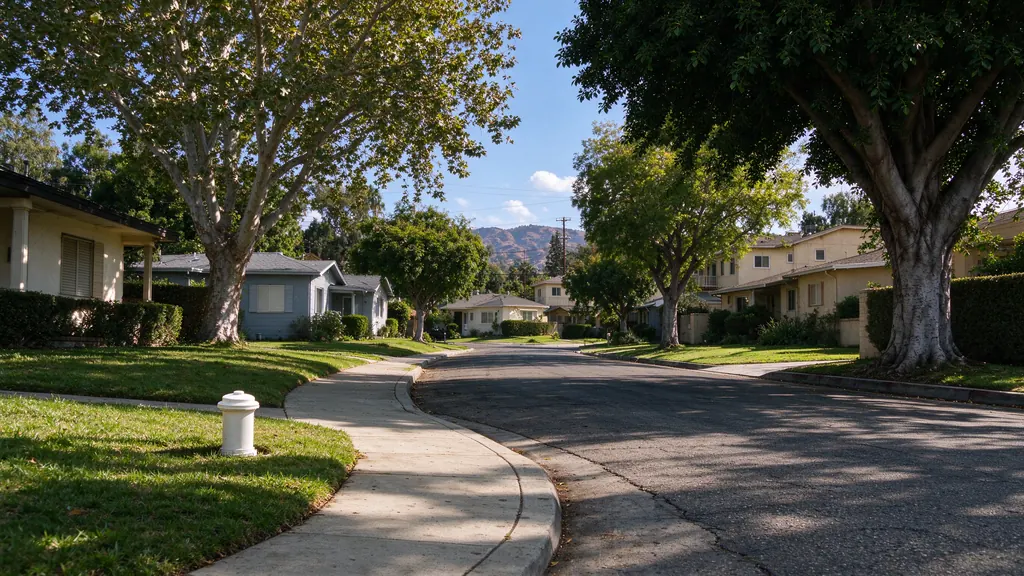
Sewer line repair in Sherman Oaks and Studio City starts with an unusual mix of ground. Angeleno Sewer Line Repair works on private laterals across both neighborhoods, from the flats north of Ventura Boulevard to the canyon streets climbing toward Mulholland. Both are part of the City of Los Angeles, so the lateral is yours from the house to the main in the middle of the street, and the City’s permits apply on both sides of the property line.
What sets this stretch of the Valley apart is what sits under it. The Los Angeles River runs along the north side of Ventura Boulevard, the Santa Monica Mountains rise to the south, and the two produce very different conditions for a sewer line a few feet underground.
What the ground does here
The California Geological Survey’s hazard report for the Van Nuys quadrangle, which covers Sherman Oaks and Studio City, describes relatively shallow groundwater near the Los Angeles River and in the canyons of the Santa Monica Mountains, with deeper groundwater farther north. It also records that shaking in the 1994 Northridge earthquake was very intense across the quadrangle and that structural damage was widespread in the Sherman Oaks area. In Studio City, on the 12500 block of Ventura Boulevard, the ground beneath a bank building cracked in a way a geotechnical engineer attributed to lateral spreading.
None of that tells you what happened to your particular lateral. It does explain why offsets, where one section of pipe has shifted relative to the next, are worth looking for on camera here. Rigid clay pipe joined in short sections does not flex with moving ground; it separates at the joints. An offset can sit quietly for decades and then start catching paper and admitting roots.
Groundwater matters in a different way. A lateral connection that is deep, or a long trench close to the river, can meet water before it meets the pipe. That turns a dig into a dewatering job, and it is one reason trenchless methods get serious consideration near the channel.
Housing age and what is in the ground
The Census Bureau’s 2020–2024 estimates put the median year built at 1966 in ZIP 91423 and 1971 in 91403, both in Sherman Oaks, and 1972 in 91604 and 1973 in 91602 in Studio City. Those medians include the apartment and condominium buildings along the boulevards. Behind them, a large share of the single-family streets predate them: in 91423, about 41 percent of all housing units were built before 1960.
A house from the 1940s or 1950s that still has its original lateral is now running on pipe roughly 70 years old. Age alone does not mean failure, and plenty of old clay lines film clean. It does mean that a recurring backup in an older Sherman Oaks or Studio City house deserves a camera before anyone recommends a fix.
Hillside lots south of Ventura
South of Ventura Boulevard the streets climb into Coldwater, Laurel and Fryman canyons, and the laterals climb with them. A hillside lateral often runs down a slope, under stairs or past retaining walls before it reaches the street, and the space to stage equipment is limited. A long open trench on a slope is slow, hard to shore and expensive to restore.
That is where the method decision has real consequences. Pipe bursting needs a pit at each end but not a trench between them. Lining can often be done from a cleanout. Neither fixes a belly, which needs the slope re-established by excavation, and lining is ruled out where a section has collapsed. On a hillside lot the camera finding and the access points decide which option is practical.
How a job runs in Sherman Oaks and Studio City
The first step is the camera inspection from the cleanout, with the defects located and marked on the surface. If the line has no usable cleanout, adding one often comes first. From the footage the scope is set: a spot repair if the problem is one section, or a replacement by the method the line allows.
Private-side work is permitted through LADBS. If the camera shows the lower lateral under the street has failed, that section needs a Bureau of Engineering S-Permit and a City Bonded Sewer Contractor. On Ventura Boulevard, Coldwater Canyon or Laurel Canyon that also brings traffic control and, potentially, restrictions on working hours. The City inspects the work before it is covered, and the post-repair video is worth keeping: LA Sanitation’s rebate program asks for it.
Many of the buildings along Ventura and Van Nuys boulevards are apartments, condominiums and restaurants. Their laterals carry more flow, and grease from commercial kitchens is a common cause of restriction. That work is covered on the commercial sewer line repair page.
Services in Sherman Oaks & Studio City
Sewer trouble in Sherman Oaks & Studio City?
Phones answered 24/7, every day.
Neighborhoods
- Sherman Oaks flats
- Sherman Oaks hills, south of Ventura
- Chandler Estates
- Studio City flats
- Colfax Meadows
- Silver Triangle
- Fryman Canyon area
Landmarks and routes
- Ventura Boulevard
- Sherman Oaks Galleria
- CBS Studio Center
- Fryman Canyon Park
- Los Angeles River channel
Main routes: US-101 (Ventura Freeway), I-405, Ventura Blvd, Coldwater Canyon Ave, Laurel Canyon Blvd, Van Nuys Blvd.
Sewer line questions in Sherman Oaks & Studio City
How much does sewer line repair cost in Sherman Oaks?
Sherman Oaks uses the same Los Angeles-area budgeting ranges as the rest of the City: about $175–$800 for a camera inspection, $1,500–$8,000 for a spot repair, and from $5,000 to $25,000 or more for full open-trench replacement, as of October 2026. Hillside access, long setbacks and any work in the street push a job toward the top of its range.
Who handles permits for sewer work in Sherman Oaks and Studio City?
Both are part of the City of Los Angeles, so private-side work needs an LADBS plumbing permit and anything in the street needs a Bureau of Engineering S-Permit, issued only to a City Bonded Sewer Contractor. Sewer backups from the City main go to LA Sanitation's 24-hour line at 1-800-773-2489.
Did the 1994 Northridge earthquake damage sewer laterals here?
The California Geological Survey reports that structural damage from the 1994 earthquake was widespread in the Sherman Oaks area, and it documents ground cracking from lateral spreading on Ventura Boulevard in Studio City. There is no public count of damaged private laterals, so a camera is the only way to know whether a particular line shifted.
Can a sewer line be replaced without digging on a hillside lot south of Ventura?
Often, because lining and pipe bursting work from a cleanout or small pits rather than a long trench up the slope. They do not suit every line: a collapsed section rules lining out, and a belly needs excavation to restore slope. The camera finding and where equipment can actually be set up decide it.
Is groundwater a problem for sewer excavation near the LA River?
It can be. The State's hazard report for this area describes relatively shallow groundwater near the Los Angeles River and in the Santa Monica Mountains canyons. Most laterals run a few feet down, but a deep connection or a long trench near the river may need dewatering, which a bid should address.