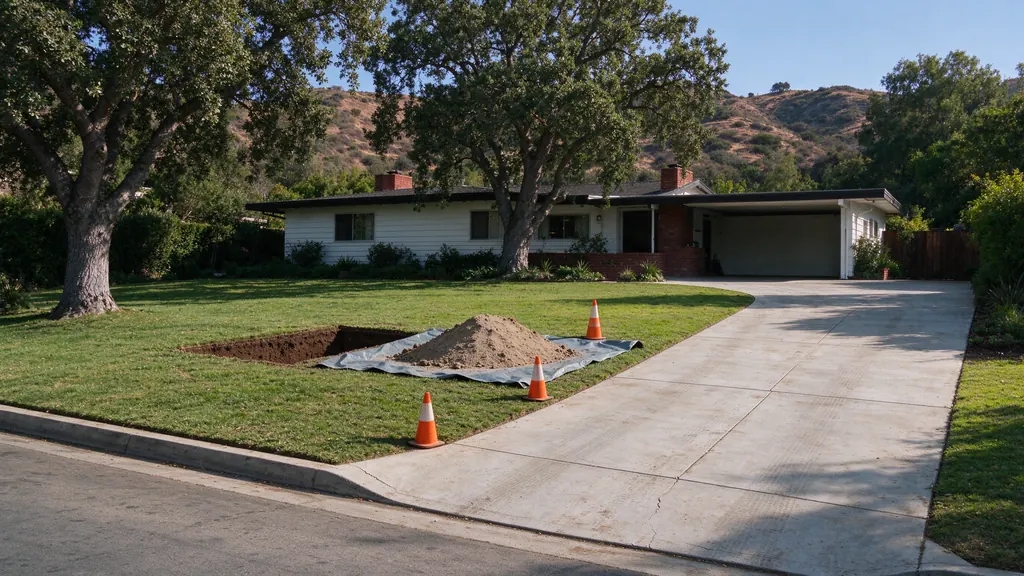
Sewer line repair in Woodland Hills, Tarzana and Encino often comes down to a question that smaller city lots rarely raise: on a long lateral, do you fix the defects the camera finds, or replace the whole run? Angeleno Sewer Line Repair covers private sewer laterals across all three communities, from the flats north of Ventura Boulevard to the hillside streets climbing toward Mulholland Drive, with the work performed by licensed, bonded and insured contractor partners.
All three communities are part of the City of Los Angeles. LA Sanitation makes the property owner responsible for the entire lateral: the upper section from the house to the property line, and the lower section from the property line to the City main in the middle of the street. City permits apply on both sides of that line.
Why the length of the line changes the decision
The southwest Valley is largely a place of detached houses. Census Bureau estimates for 2020–2024 put about 74 percent of housing units in Woodland Hills ZIP 91364 in single-family detached homes, and about 82 percent in Encino’s 91436. Where a house sits well back from the street, or the lot is deep, the lateral is longer, and a longer line built from short pipe sections has more joints and more places for something to go wrong.
That changes how camera findings add up. On a short lateral with one cracked joint, a spot repair is an easy call. On a long one, the camera may find a root intrusion near the house, an offset joint halfway down the yard and a crack near the property line. Each of those could be fixed on its own, but every separate dig carries its own excavation, shoring where needed, and restoration of whatever sits on top: a lawn, a pool deck, a long driveway. Meanwhile the sections nobody touched keep aging.
The table below is how that reasoning usually runs. It is a starting point for a conversation about the footage, not a rule.
| What the camera shows | Usual direction | Why |
|---|---|---|
| One defect, sound pipe on both sides | Spot repair | One dig fixes the only problem; the rest of the line has life left. |
| Two or three defects clustered in one stretch | Section replacement | One longer trench or one burst between two pits covers them all. |
| Defects at joint after joint along the run | Full replacement | Repeated digs cost more than one method applied to the whole line, and the joints that look fine today are the same age. |
| A sag or belly holding water | Excavation of that section | Only digging restores slope; lining and bursting follow the existing grade. |
| A collapsed section | Excavation at the collapse | Lining needs an open pipe to cure inside. |
On a long lateral the method question follows. Pipe bursting pulls a new pipe along the old path from one pit to another, which avoids a trench the full length of a yard. Lining can bridge cracks and roots from a cleanout but not a belly or a collapse. The full replacement page explains how those choices are made.
Access to the far end of the line
A camera cable and a root-cutting head both have to reach the end of the lateral. On a long run with a single cleanout at the house, the street end can be at the edge of what the equipment reaches cleanly, and a blockage near the main can be hard to clear and hard to film. That is one reason a second cleanout near the property line comes up on longer laterals. It gives a closer launch point for the camera, a second access for future cleaning, and a clear dividing point between the upper and lower lateral. The cleanout installation page covers what that involves.
Locating matters more on a long line too. Before anyone prices a dig, the defects should be located on the surface, with their distance from the cleanout and approximate depth marked. A quote that does not say where the repair will happen is hard to compare with one that does.
What the ground does here
The California Geological Survey’s hazard report for the Canoga Park quadrangle, which covers Tarzana, Encino, Woodland Hills, Reseda and Canoga Park, places a widespread liquefaction zone across the southern San Fernando Valley, especially within about a mile of the Los Angeles River. It also describes a broad area of shallow groundwater in the Reseda and Canoga Park area and a floodplain deposit there that is dominantly clay. The neighboring Calabasas quadrangle report says its liquefaction zone in Los Angeles County is mainly in Woodland Hills and nearby western Valley communities, and it records that after the 1994 Northridge earthquake a Woodland Hills shopping center beside the Dry Creek channel settled unevenly by up to 4.5 inches.
South of Ventura Boulevard, the picture changes. The Canoga Park report notes that rocks highly susceptible to landsliding and deeply cut hillsides on the north slope of the Santa Monica Mountains put about half of the upland terrain, outside the Simi Hills and Chalk Hills, in an earthquake-induced landslide zone. The Calabasas report describes widespread and abundant landslides in its dissected hills and weak rocks.
None of that says what happened to any one lateral. It does explain what to look for. Rigid pipe in ground that shifted can separate or offset at the joints, and on a long run there are many joints. On a hillside lot, a long trench down a slope is slow to dig, hard to shore and costly to restore, which is where bursting between two pits often earns a closer look.
Housing age
The Census estimates put the median year built at 1967 in Woodland Hills 91364 and 1975 in 91367, which includes the apartments around Warner Center. Tarzana’s 91356 has a median of 1973, with about 57 percent of its units built between 1960 and 1979. Encino’s medians are 1969 in 91316 and 1962 in 91436, where about 44 percent of units date from 1940 to 1959. Fewer than 3 percent of units in any of these ZIPs were built before 1940.
So most original laterals here are somewhat younger than in the older Valley neighborhoods to the east, roughly 50 to 70 years old for a house that has never had its line replaced. Age is context, not a diagnosis. Plenty of lines that age film clean, and the camera, not the build year, should decide whether anything needs doing.
How a job runs in Woodland Hills, Tarzana and Encino
It starts with a camera inspection from the cleanout, recorded with distances, and the defects marked on the surface. If the line has no usable cleanout, adding one may come first. From the footage the scope is set: repair the sections, replace a stretch, or replace the whole lateral, and by which method the line allows.
Private-side work is permitted through LADBS. If the lower lateral under the street has failed, that section needs a Bureau of Engineering S-Permit issued to a City Bonded Sewer Contractor, and work on a street like Ventura or Topanga Canyon Boulevard brings traffic control with it. The City inspects the work before it is covered. Keep the before and after video: LA Sanitation’s lateral rebate program asks for it, and on a long line it also shows any future buyer exactly what was replaced. For permit detail, see the sewer permit guide.
Services in Woodland Hills, Tarzana & Encino
Sewer trouble in Woodland Hills, Tarzana & Encino?
Phones answered 24/7, every day.
Neighborhoods
- Woodland Hills
- Warner Center
- Walnut Acres
- Tarzana
- Encino
- Encino Hills
Landmarks and routes
- Ventura Boulevard
- Pierce College
- Los Encinos State Historic Park
- Sepulveda Basin Recreation Area
- Encino Reservoir
Main routes: US-101 (Ventura Freeway), I-405, Ventura Blvd, Topanga Canyon Blvd, Reseda Blvd, Mulholland Dr.
Sewer line questions in Woodland Hills, Tarzana & Encino
How much does sewer line repair cost in Woodland Hills?
Woodland Hills, Tarzana and Encino use the same Los Angeles-area budgeting ranges as the rest of the City: about $175–$800 for a camera inspection, $1,500–$8,000 for a spot repair, and from $5,000 to $25,000 or more for full open-trench replacement, as of October 2026. A long run from a set-back house, hillside access or work in the street pushes a job toward the top of its range.
Should I repair sections or replace the whole lateral on a long lot?
It depends on how the defects are spread along the line. One or two isolated problems with sound pipe between them usually point to spot repairs. Defects at joint after joint along a long run usually point to replacement, because every separate dig carries its own excavation and restoration while the untouched pipe keeps aging. The camera footage, with each defect located by distance, is what the decision should rest on.
Is my Tarzana or Encino home in a liquefaction or landslide zone?
The California Geological Survey maps both kinds of zone for this area. Its Canoga Park quadrangle report places much of the southern valley floor in a liquefaction zone, especially near the Los Angeles River, and about half of the upland terrain south of the valley in an earthquake-induced landslide zone. A zone is a mapped hazard, not proof that a particular lateral has moved; only a camera inspection shows that.
Who pays for the part of the sewer line under the street in Encino?
The property owner. Encino, Tarzana and Woodland Hills are all in the City of Los Angeles, where LA Sanitation makes the owner responsible for the whole lateral, out to the City main in the middle of the street. Work on the street section needs a Bureau of Engineering S-Permit issued to a City Bonded Sewer Contractor.
Do I need a second cleanout on a long sewer line?
Not always, but it often helps. A camera and a cutting head both have to reach the far end of the line, and on a long lateral with one cleanout at the house, the street end can be hard to reach or clear. A cleanout nearer the property line shortens that reach and gives a second access point for future maintenance.