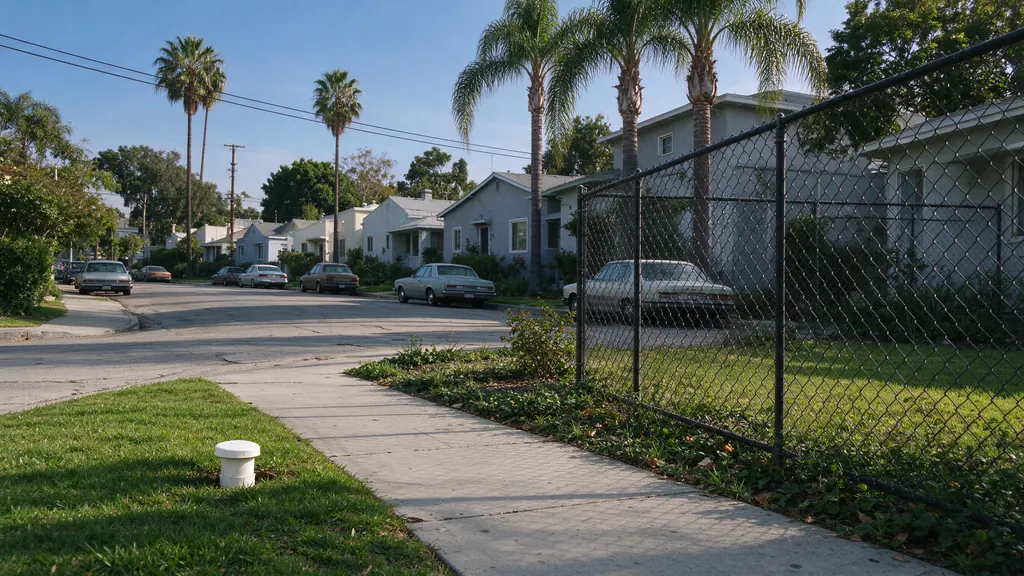
Sewer line repair in North Hollywood and Van Nuys usually happens on flat ground, and that changes the method question. Angeleno Sewer Line Repair covers private sewer laterals across both neighborhoods, from the NoHo Arts District to the streets around Van Nuys Airport, with the work performed by licensed, bonded and insured contractor partners. On a level, open lot the choice is often less about whether you can dig and more about whether digging is the better repair.
Both neighborhoods are part of the City of Los Angeles. LA Sanitation makes the property owner responsible for the entire lateral, from the house to the City main in the middle of the street, and City permits apply on both sides of the property line.
Postwar tracts and the lines under them
Much of the single-family housing here went up in the years after World War II. The Census Bureau’s 2020–2024 estimates put about 41 percent of housing units in North Hollywood ZIP 91606 in buildings from 1940 to 1959, along with 39 percent in 91605 and 40 percent in Van Nuys 91406. Median years built run from 1962 to 1969 across 91605, 91606, 91401, 91406 and 91411, pulled later by the apartments built on the same blocks since.
A house from that postwar wave that still has its original lateral is running on pipe roughly 65 to 85 years old. That is context, not a verdict. Old lines often film clean, and the camera, not the build year, should decide whether the pipe needs work. When it does, the clay sewer pipe replacement page explains what is usually found in a line of that age.
Why the slope of a flat-lot line matters
The State’s hazard report for the Van Nuys quadrangle describes most of it as the gently sloping to flat-lying floor of the San Fernando Valley. A sewer lateral depends on gravity, and the City’s standard for new house connections is a minimum 2 percent slope, about a quarter inch per foot. On flat ground there is not much fall to spare between the house drain and the main, so a section that has settled, or was laid with too little slope in the first place, can end up holding water.
That low spot, called a belly or sag, collects paper and solids and is a common reason a line keeps clogging after it has been cleared. It also matters for the repair. Pipe bursting pulls the new pipe along the path of the old one and generally carries the sag with it, and a liner follows the existing pipe in the same way. The only fix for a true belly is to dig that section and re-lay it at a proper grade, which is what sewer line belly repair covers. A camera with a level reading, or footage showing standing water over a measured distance, is what shows whether a sag is real and how long it is.
Trench or trenchless on a flat, open lot
On many tract lots the lateral runs from the house across a front yard to the street, with nothing heavier on top than lawn and a walkway. In that setting a conventional open trench is often practical. It lets the crew see the whole pipe, correct slope anywhere along the run and make clean connections at each end.
Trenchless repair earns its place when what sits above the line is expensive to remove: a driveway, a slab addition, mature trees, a pool deck or the street itself. Trenchless is not zero excavation either; bursting needs a pit at each end and lining needs access at a cleanout or a small dig.
| Situation on the lot | Often favors | Reason |
|---|---|---|
| Open yard, line under lawn or planting | Open trench | Restoration is simple and the trench allows slope to be corrected. |
| Belly or poor slope found on camera | Excavation of that section | Bursting and lining follow the old grade. |
| Line under a driveway, slab or hardscape | Bursting or lining | Avoids breaking and replacing what sits on top. |
| Failed section under the street | Depends on the camera and the City inspector | Street work needs an S-Permit; lining in the right-of-way needs City CCTV before and after, and the inspector decides whether lining is feasible. |
Many lines end up with a mix: a dug section where slope has to be corrected and a trenchless method elsewhere. The repair or replace guide works through how to weigh that.
What the ground does here
The Van Nuys quadrangle report draws a liquefaction zone across the whole quadrangle, from south of Ventura Boulevard to just north of Victory Boulevard, covering about a third of it. It describes the younger sediments of the Pacoima and Tujunga fan, which underlie much of this part of the Valley floor, as having generally high liquefaction susceptibility where groundwater has been within 40 feet of the surface, with groundwater deeper toward the north. The Burbank quadrangle report, which takes in North Hollywood and Toluca Lake, draws its zone across about 15 square miles of valley floor up to about three miles north of the Los Angeles River, while noting no documented historic liquefaction in that quadrangle. Both reports record that in the 1971 San Fernando and 1994 Northridge earthquakes, liquefaction-induced ground displacement damaged roads and utility pipelines in southern California.
For a lateral that means two practical things. Rigid pipe in ground that has moved can offset or separate at its joints, so offsets are worth looking for on camera. And the fan deposits are described as mostly sand and silty sand, which matters in a trench: loose, sandy walls do not stand on their own for long, and trench entry at five feet or more requires a protective system under Cal/OSHA rules. A connection deep enough to need shoring adds time and cost, and a bid should say how it will be handled.
Apartments and commercial buildings
North Hollywood and Van Nuys have a large share of multi-unit housing. The Census estimates put about 70 percent of units in 91601 and 66 percent in 91405 in buildings of five or more units. A lateral serving an apartment building carries more flow, the consequences of a backup reach more households, and the owner, not the residents, is responsible for the line. Restaurants along Lankershim, Magnolia and Van Nuys Boulevard add grease to the mix. That work is covered on the commercial sewer line repair page.
How a job runs in North Hollywood and Van Nuys
It starts with a camera inspection from the cleanout, with defects located and any standing water measured. From that footage the scope is set: a section repair, a full replacement, or a mix of trench and trenchless. Private-side work is permitted through LADBS. A failed lower lateral needs a Bureau of Engineering S-Permit and a City Bonded Sewer Contractor, and on a boulevard that also brings traffic control. The City inspects before the work is covered, and the post-repair video is worth keeping for LA Sanitation’s rebate program.
Services in North Hollywood & Van Nuys
Sewer trouble in North Hollywood & Van Nuys?
Phones answered 24/7, every day.
Neighborhoods
- NoHo Arts District
- Mid-Town North Hollywood
- North Hollywood West
- Valley Glen
- Van Nuys
- Toluca Lake
Landmarks and routes
- North Hollywood Metro station
- Van Nuys Airport
- Van Nuys Civic Center
- Tujunga Wash
- Sepulveda Basin
Main routes: SR-170 (Hollywood Freeway), US-101, I-405, Lankershim Blvd, Van Nuys Blvd, Victory Blvd, Sherman Way.
Sewer line questions in North Hollywood & Van Nuys
How much does sewer line repair cost in North Hollywood?
North Hollywood and Van Nuys use the same Los Angeles-area budgeting ranges as the rest of the City: about $175–$800 for a camera inspection, $1,500–$8,000 for a spot repair, and from $5,000 to $25,000 or more for full open-trench replacement, as of October 2026. Work in a busy street such as Lankershim or Van Nuys Boulevard, or a deep connection that needs shoring, pushes a job toward the top of its range.
Is trenchless worth it on a flat lot in Van Nuys?
Sometimes, and sometimes not. On a flat, open yard a conventional trench is often practical, and it is the only method that can correct a section with poor slope. Trenchless earns its place when the line runs under a driveway, a slab, mature landscaping or the street, where restoration would cost more than the method saves. The camera finding and what sits above the line decide it.
Can pipe bursting fix a belly in my sewer line?
No. Bursting pulls the new pipe along the path of the old one, so a sag in the old line is generally carried into the new one, and lining follows the existing pipe the same way. A section that holds water has to be dug up and re-laid at a proper slope. The rest of the line can still be replaced by a trenchless method if it suits.
Are North Hollywood and Van Nuys in a liquefaction zone?
Parts are. The California Geological Survey's Van Nuys quadrangle report draws a liquefaction zone across the whole quadrangle from south of Ventura Boulevard to just north of Victory Boulevard, and its Burbank quadrangle report draws one up to about three miles north of the Los Angeles River. A zone is a mapped hazard, not evidence that a particular lateral has moved.
Who fixes the sewer line for an apartment building in North Hollywood?
The owner of the property. In the City of Los Angeles the owner is responsible for the whole lateral out to the City main in the street, whether the building has one unit or forty. Residents report backups to the owner or manager; the owner arranges the inspection and repair, and anything in the street needs a Bureau of Engineering S-Permit.