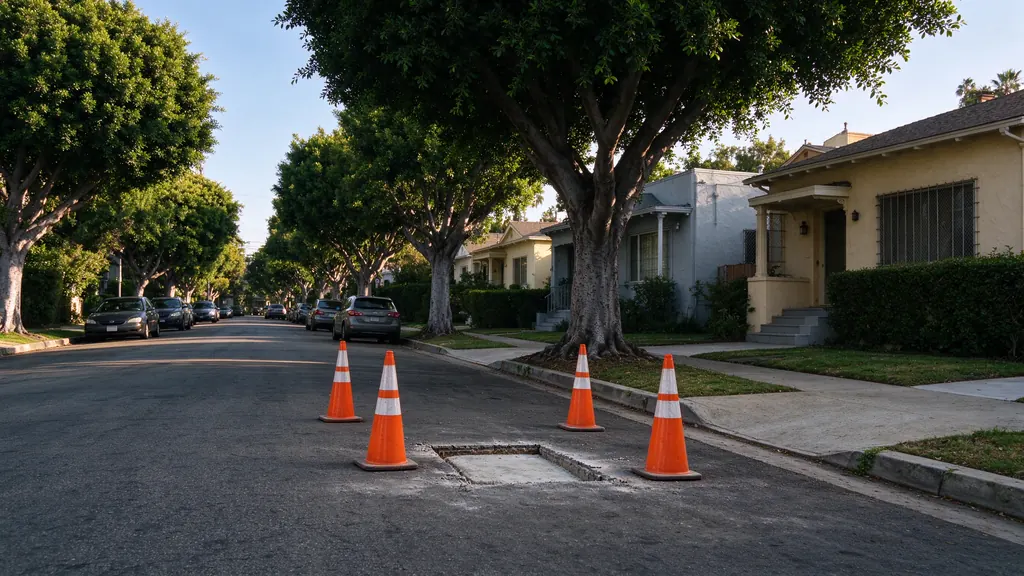
Last updated:
Sewer lateral repair under the street means fixing the lower lateral, the stretch of your sewer pipe that runs from the property line to the City main, usually in the middle of the road. In the City of Los Angeles that section belongs to the property owner, and only a City Bonded Sewer Contractor working under a Bureau of Engineering S-Permit can open the street to repair it. Angeleno Sewer Line Repair coordinates this work across Los Angeles, Pasadena, Glendale and Burbank, with right-of-way work performed by a Bonded Sewer Contractor partner.
Most owners learn the rule the hard way: a camera shows a broken joint 50 feet out, past the sidewalk, and the first call is to the City, which explains that the pipe is theirs. LA Sanitation divides every lateral into an upper lateral, from the building to the property line, and a lower lateral, from the property line to the main, and makes the owner responsible for both. The Bureau of Engineering states the same thing from the permit side: the owner maintains the house connection from the wye, or the connection at the main, to the property line, and root blockages there are the owner’s responsibility as well.
Confirming the problem is really under the street
Street work costs more and takes longer than anything on private property, so it is worth being certain before planning it. A camera inspection with surface locating should show the defect’s footage from the cleanout, where the camera crossed the property line, and the estimated depth at the defect. A sidewalk, parkway and curb sit between most front yards and the street, so a defect at 30 feet may still be on your side while one at 50 feet usually is not. If the property line location is unclear, a survey marker or the parcel map settles it.
Depth matters as much as position. The City’s standard plans call for new house connections to be at least 4 feet deep at the property line with at least a 2% slope down to the main, so the lateral keeps getting deeper as it heads into the street. Older connections do not always match the standard, and the main itself can sit well below the lateral’s depth at the property line. The depth at the connection, more than the length of pipe, drives the cost of an open cut. Our sewer depth guide covers the range.
The S-Permit and who can pull it
Any repair, replacement or rehabilitation of the house connection in the public right-of-way needs an S-Permit from the Bureau of Engineering, and the City issues it only to a contractor on its active Bonded Sewer Contractor list. That applies to excavation, lining and pipe bursting alike.
There is one narrower case. Where an existing house connection already reaches the property line and the work is only reconnecting the private lateral to it, the Bureau of Engineering allows a plumber or contractor who is not on the bonded list to obtain that property-line connection S-Permit. Reconnecting a lateral that was capped requires CCTV first, with inspection by an LADBS plumbing inspector. It does not cover repairing the pipe under the street.
The fees are set by the City and are small next to the construction. Under the current schedule:
| City fee | Amount | Notes |
|---|---|---|
| S-Permit | $273 | Plus City surcharges of 7% and 3% |
| House connection inspection | $2.84 per linear foot | Inspection by the Bureau of Contract Administration |
| Additional inspection trip | $42 | When more than the scheduled visits are needed |
| Street Damage Restoration Fee | Per square foot of pavement removed | Set by street classification and how recently it was resurfaced; $8.24 on a local street and $19.44 on a select street |
The Street Damage Restoration Fee is charged under LAMC 62.06 when asphalt pavement and base are removed, and a separate slurry seal fee applies where the street was slurry sealed within the last two years. A freshly resurfaced street costs more to cut, which is one reason trenchless methods get a serious look in the right-of-way. The Los Angeles sewer permit guide covers the private-side LADBS permit that usually travels with an S-Permit.
How the repair is done in the right-of-way
Open cut. The street is saw-cut and excavated at the defect or along the lateral, the failed pipe is replaced on proper bedding, and the excavation is backfilled and paved. It is the only reliable way to rebuild lost slope (see sewer line belly repair), and it handles collapsed pipe and a damaged wye. Trenches 5 feet and deeper need shoring or another protective system under Cal/OSHA and federal OSHA rules, and in a street they are often deeper than that.
Lining. A cured-in-place liner can rehabilitate the lower lateral from a cleanout, often without cutting the street. The City requires CCTV before and after lining in the right-of-way, and a Bureau of Contract Administration inspector assesses the lateral and decides whether lining is feasible. A liner follows the shape of the host pipe, so it does not correct a sag, and it cannot be installed through a collapse. See sewer pipe lining.
Pipe bursting. A new pipe is pulled through the old path from a pit on private property toward a pit near the main. The Bureau of Engineering requires bursting to be done by a Bonded Sewer Contractor with CCTV before and after, and street restoration fees still apply to any pit in the pavement. Trenchless does not mean no excavation; the connection at the main usually needs its own pit. See pipe bursting.
When the City’s inspector reviews lateral video under an S-Permit, the footage is graded Excellent, Fair, Poor or Very Poor. A Very Poor grade means repair is required; Poor means repair is recommended, and required for cement or other non-standard pipe.
The wye and the connection at the main
The lateral joins the main through a wye or a saddle. Because the owner’s responsibility runs to that connection, a cracked wye, a lateral that has pulled away from the main, or roots growing at the junction all fall on the owner’s side. Repairing at the main is the deepest and most exposed part of the job: the excavation sits in the middle of the lane, the main has to stay in service for the rest of the block, and the inspector looks closely at the connection. If the main itself is damaged, that becomes the City’s repair, and LA Sanitation’s 24-hour line is 1-800-773-2489.
Traffic, utilities and timing
A street excavation occupies a lane or a sidewalk, and the permit comes with traffic control requirements and the City’s peak hour restrictions, which limit when work can happen on many streets. Gas, water, electric and telecom lines cross the path of most laterals, and underground utilities must be marked through the 811 notification system before anyone digs. Street trees, hydrants, streetlights and meter boxes in the parkway can complicate access.
Street trees deserve their own note. StreetsLA’s published policy is that sewer lateral repair and associated tree costs, including root pruning and tree removal, are at the owner’s expense. Root pruning on a City tree needs a StreetsLA permit, which is free.
Why few contractors bid it
Owners often call several plumbers and get one bid, or none. The reasons are structural. A contractor needs the City sewer bond to pull the permit at all. Then come traffic control, shoring, City inspection scheduling, utility conflicts, restoration standards and liability for an open hole in a public street. Work that is routine on private property becomes a different business in the right-of-way. A thin field is not proof of a high price, but it is a reason to read each bid carefully: does it name the method and footage, the depth at the connection, the restoration and the City fees, and who handles traffic control? The guide on comparing sewer repair quotes lists the line items.
There is no reliable published range for street-side lateral work on its own, because depth, street classification, traffic and method vary so much from block to block. A short repair at 9 feet in a busy street can cost more than a long one at 5 feet on a quiet residential block.
Outside the City of Los Angeles
Other jurisdictions set their own rules. In unincorporated Los Angeles County areas served by the County’s sewer maintenance districts, the owner is responsible for the entire lateral including the part in the right-of-way. Pasadena defines the house sewer as running from 24 inches outside the building wall to the City main, maintained by the owner. Glendale and Burbank issue their own permits and handle street work their own way, and Burbank may reimburse owners for laterals crushed or misaligned by City parkway trees; check the current terms with the city before planning.
For fire rebuilds in Pacific Palisades, the City requires an S-Permit and CCTV of the existing lateral before reconnection, and a lateral that could damage the street, create sinkholes or leak must be repaired or replaced first.
Work in the public right-of-way is performed by a City of Los Angeles Bonded Sewer Contractor under the S-Permit, and private-side work by licensed, bonded and insured contractor partners. LA Sanitation’s repair rebate, up to $2,500 while funds last, requires the City-finaled permit, so keep the paperwork together.
What the work includes
- Camera inspection and surface locating to confirm the defect is past the property line, with its depth
- S-Permit application by a City Bonded Sewer Contractor, with BCA inspection scheduled
- Utility markings before excavation, and traffic control for the lane or sidewalk occupied
- Repair or replacement of the lower lateral and, where needed, the wye or connection at the main
- CCTV before and after lining or bursting, as the City requires
- Backfill and temporary paving, with the City's street restoration fee identified in the bid
- The finaled permit and post-work video handed over for your records and any LASAN rebate
Have a camera report, or a line that keeps backing up?
Phones answered 24/7, every day. Bring the video if you have one.
Related resources
- Sewer Line Replacement Permit in Los Angeles: What You Need and Who Pulls It
- Who Is Responsible for Sewer Line Repair in Los Angeles?
- What Is a Sewer Lateral? A Los Angeles Owner's Guide
- How Deep Is a Sewer Line?
- How to Compare a Sewer Line Repair Quote
- Sewer Lateral Repair Rebate in Los Angeles: Eligibility, Documents and Deadlines
Representative jobsite views
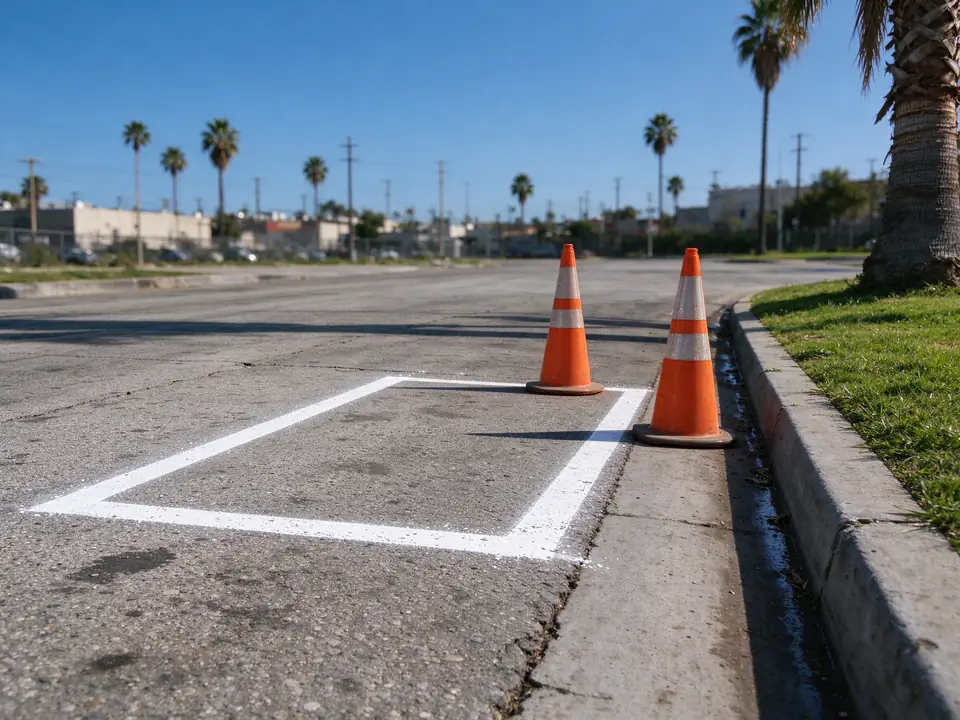
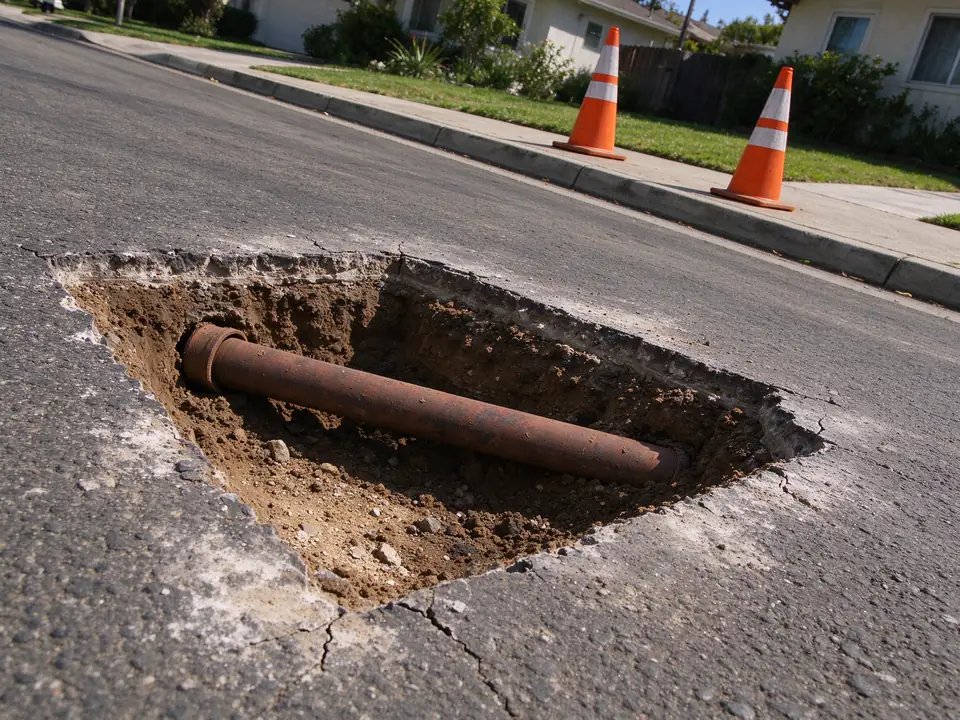
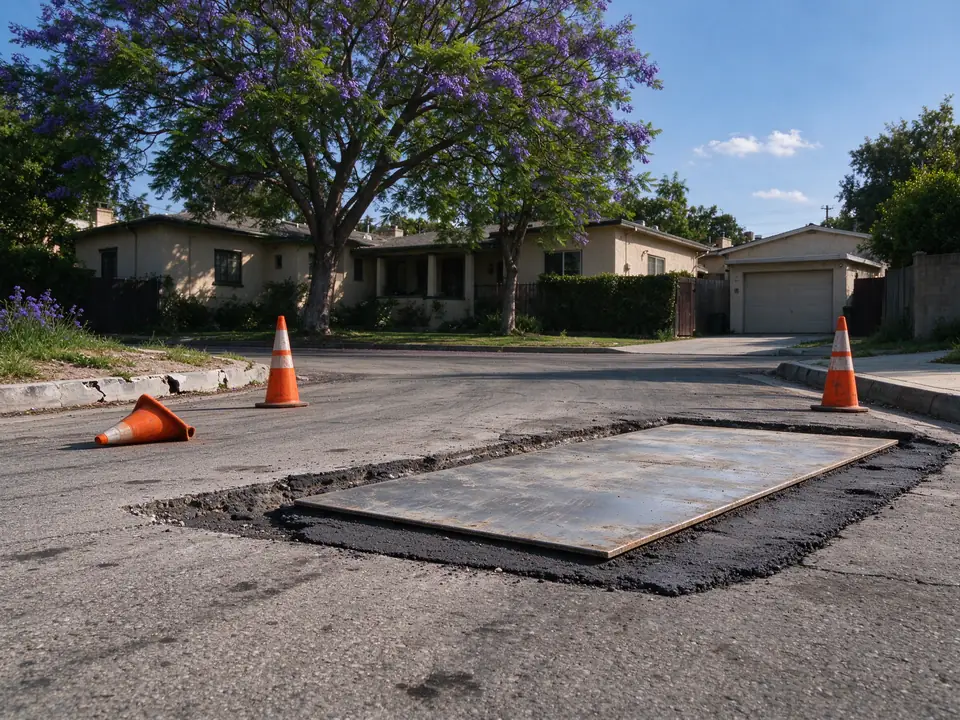
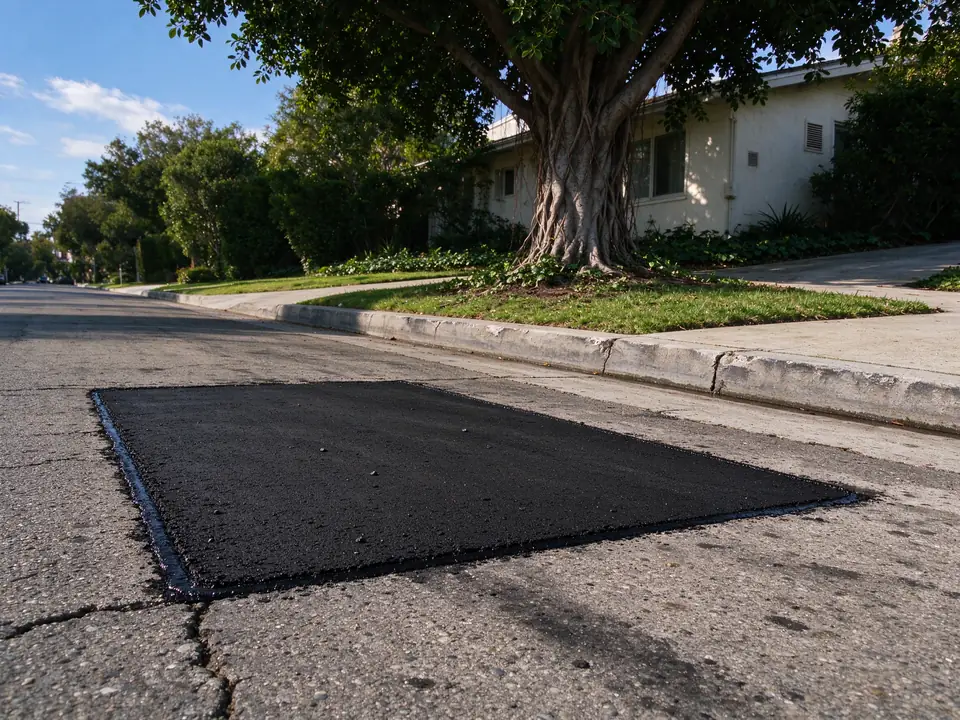
Representative illustrations of this kind of work, not photos of a specific job.
Questions people ask
Is the City responsible for the sewer pipe under the street in Los Angeles?
Not the lateral. The City maintains the main in the middle of the street, but LA Sanitation and the Bureau of Engineering both make the property owner responsible for the lateral all the way to the main, including the lower section under the pavement and the connection at the wye. Roots in that section are the owner's responsibility too.
Who can repair a sewer lateral under the street in Los Angeles?
Only a contractor on the City's active Bonded Sewer Contractor list, under a Bureau of Engineering S-Permit. A general plumber can pull a property-line reconnection S-Permit where an existing house connection reaches the property line, but repairing, replacing, lining or bursting the lower lateral needs a Bonded Sewer Contractor.
Why is it hard to get bids for sewer work in the street?
Few contractors carry the City sewer bond, and street work adds permits, City inspection, traffic control, shoring for deeper trenches, utility conflicts, restoration rules and scheduling limits on busy streets. Many plumbers who work on the private side simply do not take it on, which leaves a short list of bidders.
Can the part under the street be lined instead of dug up?
Sometimes. Lining in the right-of-way is allowed under an S-Permit, but the City requires CCTV before and after, and its inspector assesses whether the lateral is suitable for lining. A collapsed section, a large offset or a sag that needs its slope rebuilt can rule lining out.
Will the City or a utility pay if a street tree or another utility damaged my lateral?
In the City of Los Angeles, StreetsLA's policy is that sewer lateral repair and associated tree costs are at the owner's expense. If another utility's work damaged the pipe, that is a claim against the party that did the work; keep the video and records. Burbank has its own rules for laterals damaged by City parkway trees.