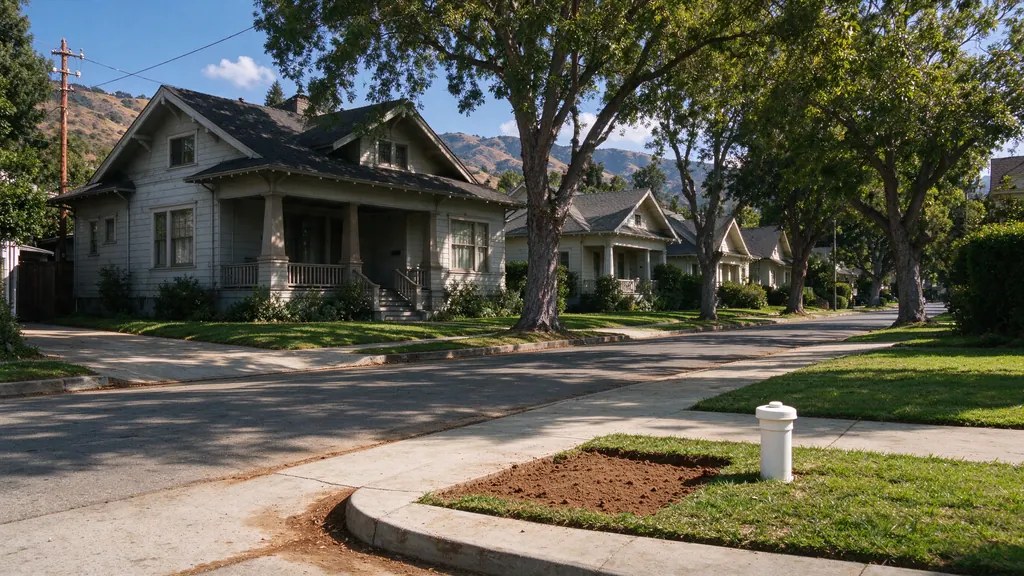
Sewer line repair in Highland Park and Eagle Rock usually involves a house old enough that its drain system was built in pieces, at different times, from different pipe. Angeleno Sewer Line Repair covers private sewer laterals across both neighborhoods, from the flats along Figueroa Street and York Boulevard to the slopes of Mount Washington and the streets around Occidental College, with the work performed by licensed, bonded and insured contractor partners. The decision that comes up most here is where a replacement should begin, and how the equipment gets there.
Both neighborhoods are part of the City of Los Angeles. LA Sanitation makes the property owner responsible for the entire lateral, from the house to the City main in the middle of the street, and City permits apply on both sides of the property line.
Prewar houses, and two kinds of old pipe
The Census Bureau’s 2020–2024 estimates put the median year built at 1947 in Eagle Rock ZIP 90041, with about 43 percent of housing units built before 1940 and another 24 percent from 1940 to 1959. Highland Park’s 90042 has a median of 1952 with about 41 percent prewar, and 90065, which covers Mount Washington and Glassell Park, a median of 1952 with about 38 percent prewar. These are also neighborhoods of houses rather than apartments: about 61 percent of units in 90041 are single-family detached homes, and about 55 percent are owner-occupied.
A house from the 1910s, 1920s or 1930s may still have its original building drain running under a raised floor and its original lateral running out through the yard. The section under the house is often cast iron and the yard section often clay, but that is a pattern to check, not a fact to assume, and many houses have had one part or the other replaced along the way. Cast iron tends to fail from the inside, scaling and thinning along the bottom of the pipe until it cracks or rots through. Clay tends to fail at the joints, where roots get in and sections shift. A camera can usually tell them apart, and the footage often shows the transition where one material meets the other.
Where should the replacement start?
When the yard section needs replacing, the question becomes what to do about the pipe under the house. Leaving sound cast iron in place is reasonable. Leaving cast iron that is already scaled and cracked usually means a second project later, with the yard already restored over the new line.
| What the camera shows under the house | Usual direction | Why |
|---|---|---|
| Cast iron with light scale, no cracks | Replace the yard section only | The interior line has service left; a cleanout at the transition keeps it accessible. |
| Heavy scale, channeling along the bottom | Replace both, or descale and reassess | Channeled pipe is close to failing; descaling shows how much wall remains. |
| Cracks or holes in the cast iron | Replace both together | Doing it in one project avoids reopening the yard and the crawlspace twice. |
| Already replaced with plastic at some point | Yard section only | Check the joint where new pipe meets old. |
The cast iron replacement and clay pipe replacement pages go into what each material looks like on camera and how each is replaced. Where the crawlspace is tight, the interior section can sometimes be lined or burst rather than dug, subject to the same limits as outside.
Getting equipment through a side yard
Where a house sits close to one side line, the side yard may be just wide enough to walk through, with a fence, a gate and sometimes a set of steps in it. That matters more than it sounds. An excavator that would dig a front-yard trench in a morning may not fit, which turns a machine job into a hand-digging job.
Tight access is one of the stronger arguments for a trenchless method. Pipe bursting needs a pit at each end rather than a trench between them, and lining works from a cleanout. Neither fixes a sag, which has to be dug and re-laid at the right slope, and lining cannot pass a collapsed section. On a hillside lot, steps and retaining walls add to the same problem. Before any quote, it helps to know where the line runs, how deep it is at each end and what a crew can actually reach.
What the ground does here
The California Geological Survey’s Pasadena quadrangle report describes the Eagle Rock Valley as surrounded by low hills of sandstone and conglomerate, with alluvium of silty and clayey sand and interbedded clay, some of it very loose. It reports groundwater in wells in the Eagle Rock area within 10 to 20 feet of the surface, and borehole logs along Eagle Rock Boulevard that suggest a local water table perched on a clay layer. Its liquefaction zone is limited to a few places, including the Arroyo Seco and the Eagle Rock area. The report also describes the Arroyo Seco cutting a channel along the east side of the San Rafael Hills and through the Eagle Rock and Highland Park area to the Los Angeles River.
The Los Angeles quadrangle report covers the hills to the south, where the Repetto Hills rise to Mount Washington at 846 feet. It describes numerous landslide deposits on the steeper slopes of the Repetto Hills, most of them in interbedded shale, siltstone and sandstone or in soft siltstone, and shallow groundwater in the Arroyo Seco and in canyons draining those hills.
Most laterals are shallower than that groundwater, so it seldom affects a routine dig. It matters more for a deep connection low in the valley or near the Arroyo, and on Mount Washington’s slopes the bigger concern is planning a trench that will not disturb a hillside.
Roots and old joints
Old clay joints and mature trees are a familiar pairing in prewar neighborhoods. Root cutting clears a line but does not seal the joint the roots came through, so they return. If street trees are involved, StreetsLA places sewer lateral repair and associated tree costs on the property owner. The tree root repair page explains the difference between maintenance and a structural fix.
How a job runs in Highland Park and Eagle Rock
It starts with a camera inspection, ideally from a cleanout that lets the camera see both the interior drain and the yard lateral. Defects are located and marked, and the route and access are checked. From that the scope is set. Private-side work is permitted through LADBS, and a failed section under the street needs a Bureau of Engineering S-Permit and a City Bonded Sewer Contractor. If you are buying here, a pre-purchase inspection answers these questions before closing rather than after.
Services in Highland Park & Eagle Rock
Sewer trouble in Highland Park & Eagle Rock?
Phones answered 24/7, every day.
Neighborhoods
- Highland Park
- Garvanza
- Hermon
- Eagle Rock
- Mount Washington
- Glassell Park
Landmarks and routes
- Occidental College
- Eagle Rock (the boulder)
- Arroyo Seco
- Sycamore Grove Park
- Highland Park Metro station
Main routes: SR-134 (Ventura Freeway), SR-2 (Glendale Freeway), SR-110 (Arroyo Seco Parkway), Figueroa St, York Blvd, Colorado Blvd, Eagle Rock Blvd.
Sewer line questions in Highland Park & Eagle Rock
How much does sewer line repair cost in Highland Park?
Highland Park and Eagle Rock use the same Los Angeles-area budgeting ranges as the rest of the City: about $175–$800 for a camera inspection, $1,500–$8,000 for a spot repair, and from $5,000 to $25,000 or more for full open-trench replacement, as of October 2026. A narrow side yard, a line that continues under the house, or work in the street push a job toward the top of its range.
Should I replace the cast iron under my house when the clay line in the yard is replaced?
Not automatically. If the camera shows the cast iron is scaled, cracked or rotted through at the bottom, doing it while the yard line is open avoids a second project. If it films sound, leaving it can be reasonable. The decision should rest on footage of both sections, taken from a cleanout that lets the camera see each one.
Can sewer work be done through a narrow side yard?
Usually, but it shapes the method. Pipe bursting needs a launch pit and a receiving pit rather than a continuous trench, and lining works from a cleanout, so both suit tight access better than a full-length trench. Neither fixes a sag, and lining cannot cross a collapse. A side yard too narrow for small equipment may mean more hand digging, which takes longer.
Is Eagle Rock in a liquefaction zone?
Parts are. The California Geological Survey's Pasadena quadrangle report limits its liquefaction zone to a few places, including the Arroyo Seco and the Eagle Rock area, and reports groundwater within 10 to 20 feet of the surface in wells there. A mapped zone is a hazard designation, not evidence that a particular lateral has moved.
Should I get a sewer inspection before buying an older house in Highland Park?
It is worth considering. The City of Los Angeles has no point-of-sale sewer inspection ordinance that we know of, but the owner is responsible for the whole lateral out to the main in the street, and many houses here are prewar. A camera inspection during escrow shows what you are taking on and gives a basis for any negotiation.