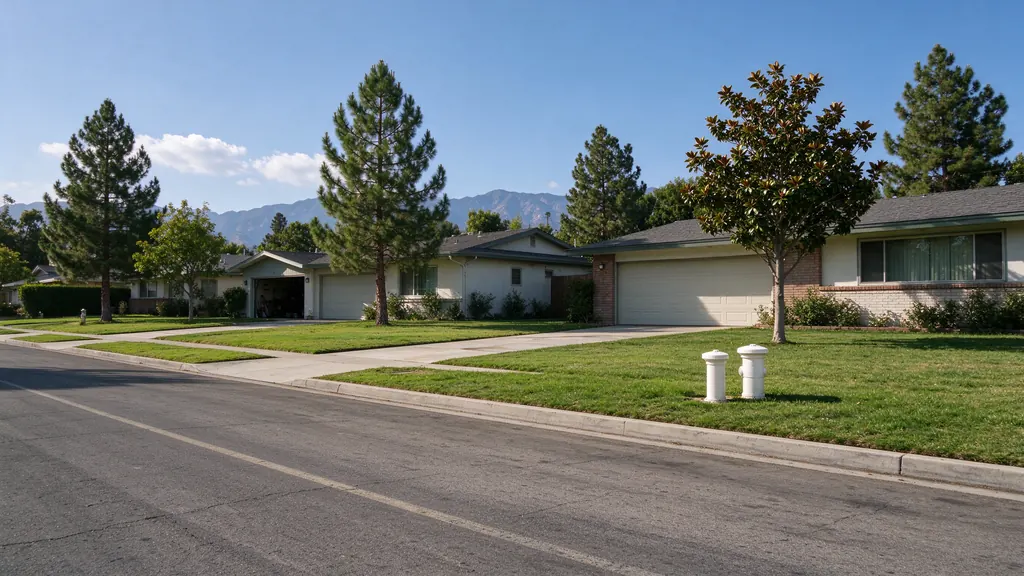
Sewer line repair in Northridge and Granada Hills usually involves a postwar lateral in ground that moved hard in 1994. Angeleno Sewer Line Repair works on private laterals across both communities, from the flats around Cal State Northridge to the streets north of the Ronald Reagan Freeway. Both are part of the City of Los Angeles, so the lateral is the owner’s from the house to the main in the middle of the street, and City permits apply on both sides of the property line.
The 1994 earthquake, in the record
The U.S. Geological Survey lists the magnitude 6.7 Northridge earthquake of January 17, 1994, with its epicenter about a kilometer south of Northridge, near Reseda, at a depth of roughly 18 kilometers. Its summary records maximum intensities of IX in and near Northridge and in Sherman Oaks, and ground cracks at Granada Hills.
The California Geological Survey’s hazard reports add detail. The San Fernando quadrangle report says the most extensive liquefaction damage in 1994 occurred near Balboa Boulevard and Rinaldi Street in Granada Hills, where liquefaction led to lateral spreading and ground cracking. It points to the Mission Hills fault, just south of that area, as a possible groundwater barrier, with groundwater within 20 feet of the surface north of the fault. The Canoga Park report says the liquefaction zone extends into Northridge where young, loose alluvium meets a shallow water table, and that an isolated sandy layer may have caused surface damage at Wynne Avenue. Both reports note that in 1971 and 1994, liquefaction-induced ground displacement caused significant damage to roads and utility pipelines in the Los Angeles area.
None of that says what happened to any particular private lateral, and no public count of damaged laterals exists. What it does explain is why offsets and sags are worth looking for on camera here, and why an old one should be judged on what it is doing now.
Postwar housing on long, single-family lots
The Census Bureau’s 2020–2024 estimates put the median year built at 1963 in ZIP 91344, in Granada Hills, where about 40 percent of units date from 1940 to 1959 and another 42 percent from the 1960s and 1970s. In Northridge ZIPs 91324 and 91325 the median is 1970. In 91344, more than four out of five homes are detached single-family houses, and most are owner-occupied.
A lateral original to a 1950s or 1960s house has now been in the ground for 60 to 70 years, and it went through the 1994 shaking. That combination is a reason to film a line before buying or before a remodel, not a reason to assume it has failed. The home buyer inspection page covers what to ask for.
An old offset: repair now or watch it
The decision that comes up most here is what to do with a defect that may have been there for decades. An offset is a joint where one length of pipe has shifted relative to the next. Rigid pipe in short sections does not bend with moving ground; it separates at the joints.
The Bureau of Engineering’s camera grading for permits gives a useful scale. Minor cracks, offsets or root intrusion grade Fair, and no repair is recommended. Moderate cracks or offsets, or extensive roots, grade Poor, where repair is recommended but not required. Major cracks or offsets, a collapse or a blocked line grade Very Poor, where the City requires repair. Outside a permit, the same logic helps an owner decide.
A small offset that does not catch paper or show roots can often be left and filmed again in a few years. An offset with a lip that snags debris, roots growing through the gap, or cracking spreading from the joint is a spot repair candidate. Several offsets along the run, or a belly where the line has settled and holds water, change the answer: lining does not correct a belly, and a line with problems at many joints is usually better replaced. Clearing a line that keeps blocking restores flow but repairs nothing.
Street trees
The StreetsLA tree inventory lists the crape myrtle as the most common inventoried street tree in the Northridge East and South and the Granada Hills North and South neighborhood council areas, and the Canary Island pine in Northridge West. Roots enter laterals through joints that already leak, which makes an offset joint an easy entry point. StreetsLA’s policy puts lateral repair and associated tree costs on the owner.
How a job runs in Northridge and Granada Hills
Camera first, from a cleanout, with each defect located and its distance from the house recorded. Private-side work is permitted through LADBS. A failed lower lateral needs a Bureau of Engineering S-Permit and a City Bonded Sewer Contractor; on Balboa, Reseda or Devonshire that also brings traffic control. The repair vs replacement guide walks through the choice in more detail, and the post-repair video and final permit are what LA Sanitation’s rebate program asks for.
Services in Northridge & Granada Hills
Sewer trouble in Northridge & Granada Hills?
Phones answered 24/7, every day.
Neighborhoods
- Northridge
- Granada Hills
- Balboa Highlands
- Knollwood
- North Hills
- Porter Ranch
Landmarks and routes
- California State University, Northridge
- Northridge Fashion Center
- O'Melveny Park
- Van Norman Lakes
- Bull Creek
Main routes: I-405 (San Diego Freeway), SR-118 (Ronald Reagan Freeway), Reseda Blvd, Balboa Blvd, Devonshire St, Nordhoff St, Rinaldi St.
Sewer line questions in Northridge & Granada Hills
How much does sewer line repair cost in Northridge or Granada Hills?
Northridge and Granada Hills use the same Los Angeles-area budgeting ranges as the rest of the City: about $175–$800 for a camera inspection, $1,500–$8,000 for a spot repair, and from $5,000 to $25,000 or more for full open-trench replacement, as of October 2026. A long run on a larger lot, a sag that has to be regraded or work under the street pushes a job toward the top of its range.
Was my sewer line damaged in the 1994 Northridge earthquake?
There is no public count of damaged private laterals, so nobody can say from the address alone. The State's hazard reports document liquefaction and ground cracking in parts of Granada Hills and Northridge in 1994, and note damage to utility pipelines across the region. A camera inspection is the only way to see whether your line has an offset or a sag.
The camera found an offset joint. Does it need fixing now?
Not always. A small offset with no roots and no snagging can be monitored. A larger one that catches paper, admits roots or has started to break the pipe around it is a repair. The City's own camera grading for permits draws a similar line between minor offsets, where no repair is recommended, and major ones, where repair is required.
Should I get a sewer inspection when buying a house in Granada Hills?
We found no City rule requiring one at sale, but it is worth doing on a house of this age. Much of the housing here dates from the 1950s through the 1970s, and the lateral is the buyer's responsibility once escrow closes, including the part under the street.
Who handles permits for sewer work in Northridge and Granada Hills?
Both are part of the City of Los Angeles. Private-side work needs an LADBS plumbing permit, and anything in the street needs a Bureau of Engineering S-Permit issued to a City Bonded Sewer Contractor. Backups from the City main go to LA Sanitation's 24-hour line at 1-800-773-2489.