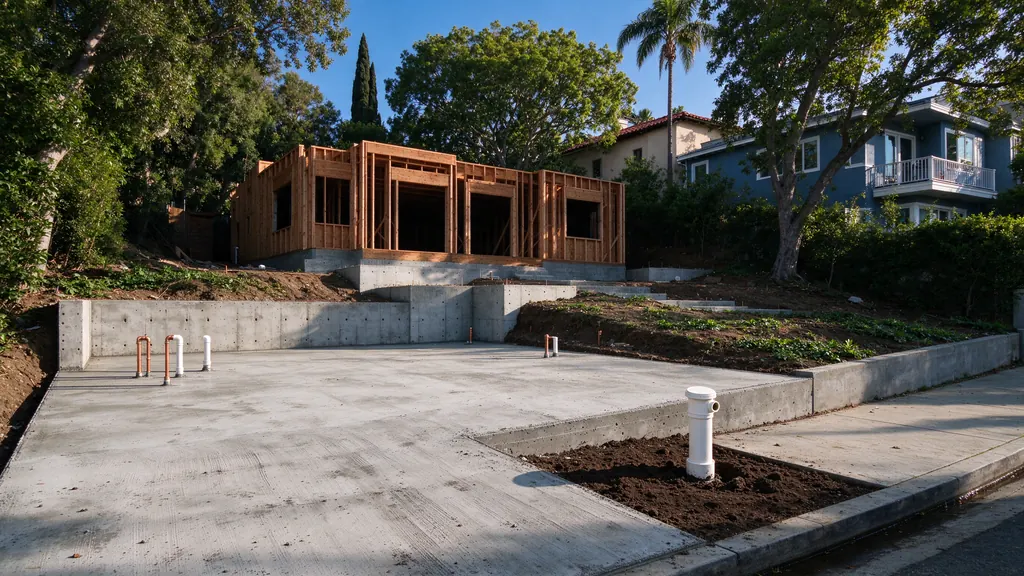
Sewer line repair in Pacific Palisades, for many owners right now, means deciding what to do with a lateral that stayed underground through the fire while the house above it was lost. Angeleno Sewer Line Repair works on private laterals across the Palisades, and for rebuild projects the work is shaped by a specific City process. The Palisades is part of the City of Los Angeles, so the owner is responsible for the lateral from the house to the main in the street, and reconnecting a rebuilt home runs through the Bureau of Engineering.
What the City requires before reconnection
The City’s June 2026 handout for Palisades rebuilding sets out three steps before a rebuilt property can reconnect: apply for an S-Permit (the Sewer Connection Permit), perform a CCTV camera inspection of the existing lateral, and schedule a City inspection before any reconnection work begins. The handout is plain that work should not start before that inspection, and that the inspector should witness and document the lateral’s condition. Unauthorized work may result in delays or corrections.
The camera is there to find root intrusion, cracks or broken pipe, offset joints, collapsed sections and blockages. The City then uses the video to decide whether the lateral can be reconnected as it is or must be repaired or replaced first. LADBS requires a sewer cap permit before a building with a sewer line is demolished, and the cap has to be inspected before it is covered. The Bureau’s general procedures then apply to any capped lateral: CCTV is needed to assess its condition before a new connection is made, unless the lateral was newly built under its own permit.
The decision: reconnect, repair or replace
The handout sorts existing laterals into a few outcomes.
- Good condition. Reconnection will be approved. An existing 4-inch lateral in good condition is generally allowed, and upsizing to 6 inches is not required solely to reconnect.
- Poor condition, no threat to the street. If sewage still flows properly and the lateral will not damage the roadway or right-of-way, the owner may choose to reconnect as-is.
- Poor condition, potential damage to the street. If the lateral could damage the roadway, create sinkholes, leak, or affect the public right-of-way, it must be repaired or replaced before reconnection.
The middle case is a real choice, and it deserves a clear head. Reconnecting as-is may mean signing an acknowledgment that the property was damaged in the 2025 fires, that the camera found existing pipe damage, and that the owner accepts responsibility for future maintenance and repairs. The handout notes that future repairs may still become necessary.
The practical question is timing. During a rebuild the yard is often open, equipment is on site and the landscaping and hardscape are not yet installed. Replacing a damaged upper lateral at that stage may be far less disruptive than coming back after the new driveway and garden are in. On the other hand, a defect that is minor and stable may not justify the cost. A camera inspection that locates each defect, and separates the private section from the part under the street, is what lets you weigh it.
When the street section is involved
If the damage is in the lower lateral, between the property line and the main, repair in the right-of-way needs a Bureau of Engineering S-Permit issued to a City Bonded Sewer Contractor. The street lateral repair page explains how that work is permitted and inspected. Where the lateral is sound enough to stay but has one bad section, a spot repair may be enough. A line damaged along much of its length is usually better replaced, and depending on what the camera shows, trenchless methods may limit digging on a lot that is already under construction.
The ground and the housing
The California Geological Survey’s hazard report for the Topanga quadrangle describes much of the Pacific Palisades district as built on a broad alluvial terrace that slopes south toward the bay. It found dense soils and deep groundwater in that terrace, and left it out of the liquefaction zone. The canyons and the mountainous terrain are different: earthquake-induced landslide zones are widespread there, and lots on steep ground bring their own access limits for any excavation.
Census estimates for 2020 to 2024, which describe the housing as it stood before the fire, put the median year built in ZIP 90272 at 1967, with about 36 percent of units built from 1940 to 1959. A rebuild that reconnects to the original lateral may be relying on pipe several decades old. Age is not a defect, but it is a reason the camera matters.
Getting help with the process
The handout lists the Bureau of Contract Administration at 213-485-5080 for scheduling the pre-construction inspection, the Urban Forestry Division at 213-847-3077 for street trees, and in-person help at the Palisades Inspections and Permitting Support Center, 16925 Marquez Ave. The permit guide explains how the S-Permit and LADBS permits fit together, and the responsibility guide covers who owns each part of the line.
Services in Pacific Palisades
Sewer trouble in Pacific Palisades?
Phones answered 24/7, every day.
Neighborhoods
- Palisades Village
- Marquez Knolls
- Palisades Highlands
- Huntington Palisades
- Rustic Canyon
- Castellammare
- The Riviera
- Alphabet Streets
Landmarks and routes
- Will Rogers State Historic Park
- Temescal Gateway Park
- Palisades Recreation Center
- Will Rogers State Beach
- Santa Monica Canyon
Main routes: Sunset Blvd, Pacific Coast Highway (SR-1), Chautauqua Blvd, Temescal Canyon Rd, Palisades Dr, Via de la Paz.
Sewer line questions in Pacific Palisades
How much does sewer line repair cost in Pacific Palisades?
Pacific Palisades uses the same Los Angeles-area budgeting ranges as the rest of the City: about $175–$800 for a camera inspection, $1,500–$8,000 for a spot repair, and from $5,000 to $25,000 or more for full open-trench replacement, as of October 2026. Hillside access and any work under the street push a job toward the top of its range. City permit and inspection fees are separate.
Do I need a camera inspection before reconnecting my rebuilt house to the sewer?
Yes. The City's Palisades rebuild handout says owners must apply for an S-Permit, perform a CCTV inspection of the existing lateral, and schedule a City inspection before any reconnection work begins. The City uses the video to decide whether the lateral can be reconnected or must be repaired or replaced first.
Will the City make me replace my sewer lateral?
Only in some cases. A lateral in good condition will be approved, and a 4-inch lateral in good condition does not have to be upsized to 6 inches just to reconnect. A lateral in poor condition that still flows and does not threaten the street may be reconnected as-is at the owner's choice. If it could damage the roadway, create sinkholes or leak, it must be repaired or replaced first.
What does reconnecting as-is mean for me later?
The handout says the owner may be asked to sign an acknowledgment that the lateral was found damaged, that it still functions, and that the owner accepts responsibility for future maintenance and repairs. Future repairs may still be needed, and they remain the owner's cost.
Who do I call to schedule the City inspection?
The handout directs owners to the Bureau of Contract Administration at 213-485-5080, or its online inspection request form, before work starts. For questions about street trees it lists the Urban Forestry Division at 213-847-3077, and in-person help is available at the Palisades Inspections and Permitting Support Center, 16925 Marquez Ave.