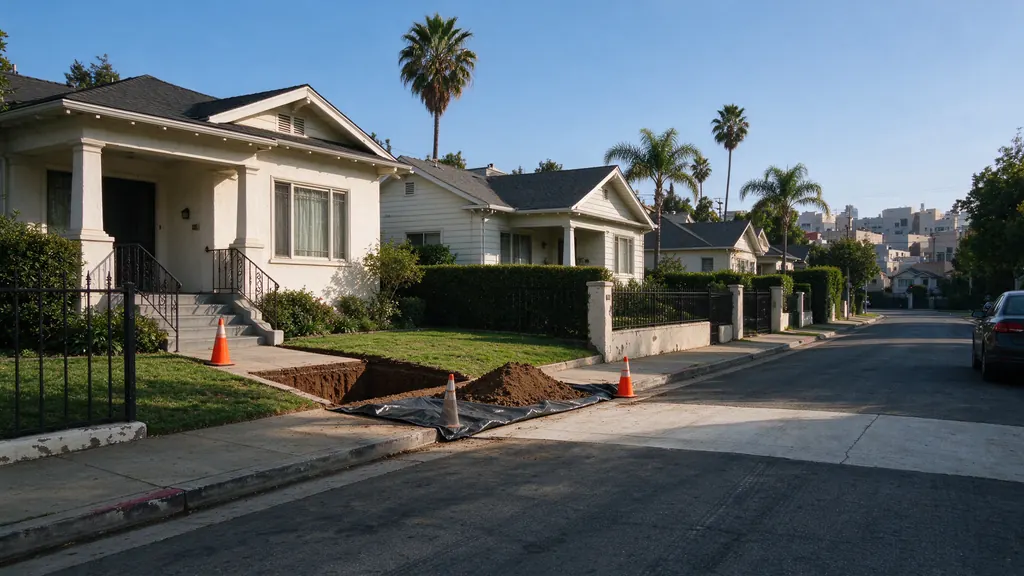
Sewer line repair in South Los Angeles usually starts with an old pipe. Angeleno Sewer Line Repair works on private laterals across South LA, from West Adams and Jefferson Park to Leimert Park, Crenshaw and Hyde Park. These neighborhoods are part of the City of Los Angeles, so the lateral is the owner’s from the house to the main in the middle of the street, and City permits apply on both sides of the property line.
The age of the housing is what sets the area apart, and it shapes more than the odds of a crack. In South LA, what the lateral is made of can decide whether a repair is optional or required once the City looks at it.
Some of the oldest housing in the City
The Census Bureau’s 2020–2024 estimates put the median year built for all housing in the City of Los Angeles at 1965. Several South LA ZIP codes sit decades earlier. In 90062 the median is 1938, earlier than any other City ZIP we checked, and about 60 percent of housing units were built before 1940. In 90018 the median is 1943, in 90047 it is 1946 and in 90043 it is 1947. In 90047, about three quarters of all units predate 1960, two thirds are detached single-family houses, and most homes are owner-occupied.
A house from the 1920s that still has its original lateral is running on pipe close to a century old. That is not a diagnosis. Old vitrified clay can last a long time, and some original lines film clean. What age does change is the range of things the camera might show: joints that have opened, sections that have settled out of line, cracks, and, in some older lines, pipe that is not clay at all.
Why the pipe material matters here
When a project in the City brings a Bureau of Engineering inspector’s camera grade into play, the Bureau’s procedures grade the lateral as Excellent, Fair, Poor or Very Poor. For a standard lateral, Poor means moderate cracks, offsets or extensive roots, and repair is recommended but not required. Very Poor, which covers major cracks, a collapse or a line that has compromised the main, makes repair required under a supplemental S-Permit.
Cement and other non-standard pipe is held to a stricter rule. If the lateral is cement, a Poor grade makes repair required, and a Very Poor grade requires reconstructing all portions of the cement pipe. The Bureau also notes that laterals found to be substandard in material or diameter are handled case by case and tend to be in locations with older sewers.
That gives South LA owners a specific reason to know what is in the ground before a project, not after. Extending an existing house connection, or reconnecting one that was capped, requires a camera inspection under the Bureau’s procedures. An owner planning an addition or a rebuild who learns at that stage that the lateral is cement may find the repair has moved from the wish list to the permit conditions. A camera inspection done early, with the material identified in writing, turns that into a budgeted decision. The inspection report guide explains what a useful report includes.
One break or the whole line
With an old line, the repair choice turns on what the rest of the pipe looks like. A single cracked section on an otherwise sound line is a reasonable spot repair. When the camera shows open joints and cracks along much of the run, or the line has collapsed in one place and is fragile elsewhere, patching tends to move the problem a few feet down the line. Full clay pipe replacement is usually the better money in that case. Clearing a blockage restores flow but repairs nothing, and a line that needs rooting every few months is telling you about its joints.
What the ground does here
The California Geological Survey’s hazard report for the Hollywood quadrangle, which takes in Crenshaw and the neighborhoods north of the Baldwin Hills, describes the southern third of the map, east of the hills, as a gently sloping alluvial surface laid down by local drainages and the ancestral Los Angeles River. The Survey describes the Baldwin Hills themselves as an uplift along the Newport-Inglewood structural zone. Soil type and earthquake history are context for what the camera finds, not proof that any particular lateral has moved.
Street trees and other causes
The StreetsLA tree inventory shows the Mexican fan palm as the most common inventoried street tree in several South LA neighborhood council areas, including Empowerment Congress North and West and United Neighborhoods. In the Park Mesa Heights area, about a third of the 10,475 inventoried planting sites are recorded as vacant. Roots still cause plenty of backups, and LA Sanitation says tree roots and poured grease together cause over half of them citywide. On a block with few parkway trees, though, a backup should not be assumed to be roots. A tree root problem, an offset and a sag look different on camera and are fixed differently.
City lots and County lots
Not every address with a South LA feel is in the City. View Park and Windsor Hills, and the unincorporated part of the Baldwin Hills, are Los Angeles County territory, and the Survey’s Hollywood report lists them as unincorporated communities. LA County Public Works says that where its sewer maintenance district serves, the owner is responsible for the entire lateral, including the portion under the street, but the permits and inspection come from the County, not from LADBS and the Bureau of Engineering.
How a job runs in South Los Angeles
Camera first, with the material, defects and depth noted. Private-side work is permitted through LADBS. If the lower lateral under the street has failed, that section needs a BOE S-Permit and a City Bonded Sewer Contractor, explained on the street lateral repair page. The City inspects before the trench is closed. Keep the final permit and the post-repair video: LA Sanitation’s rebate program, described in the rebate guide, asks for both.
Services in South Los Angeles
Sewer trouble in South Los Angeles?
Phones answered 24/7, every day.
Neighborhoods
- West Adams
- Jefferson Park
- Leimert Park
- Crenshaw
- Baldwin Village
- Hyde Park
- Vermont Square
- Vermont Knolls
- Gramercy Park
- Exposition Park area
Landmarks and routes
- Leimert Park Village
- Baldwin Hills Crenshaw Plaza
- Exposition Park
- University of Southern California
- Metro K Line along Crenshaw Blvd
Main routes: I-10 (Santa Monica Freeway), I-110 (Harbor Freeway), Crenshaw Blvd, Martin Luther King Jr. Blvd, Vermont Ave, Western Ave, Slauson Ave.
Sewer line questions in South Los Angeles
How much does sewer line repair cost in South Los Angeles?
South Los Angeles uses the same Los Angeles-area budgeting ranges as the rest of the City: about $175–$800 for a camera inspection, $1,500–$8,000 for a spot repair, and from $5,000 to $25,000 or more for full open-trench replacement, as of October 2026. A failed section under the street, a collapsed line or a lateral that has to be rebuilt end to end pushes a job toward the top of its range.
My house was built in the 1920s. Does the sewer line need replacing?
Not because of its age alone. Many old clay laterals still film clean, and a camera inspection is the only way to know. Age does mean that a recurring backup deserves a camera before anyone recommends a fix, and that a line with defects along much of its length is usually better replaced than patched.
What happens if a City inspector finds my lateral is cement pipe?
When a Bureau of Engineering permit brings a City camera grade into play, cement and other non-standard pipe is held to a stricter rule. For ordinary pipe, a Poor grade means repair is recommended; for cement pipe, the Bureau's procedures make repair required at Poor, and a Very Poor grade requires reconstructing all portions of the cement pipe.
My house is in View Park or Windsor Hills. Do City of LA rules apply?
No. View Park and Windsor Hills are unincorporated Los Angeles County, so County rules and permits apply rather than LA Sanitation's and the Bureau of Engineering's. LA County Public Works says that in the areas its sewer maintenance district serves, the owner is responsible for the entire lateral, including the part under the street. Confirm with the County before permitting work.
Is a backup in South LA usually caused by tree roots?
Roots are one common cause, but not a safe assumption. In several South LA neighborhood council areas, the StreetsLA inventory records a large share of parkway planting sites as vacant, and many lots have no tree near the lateral at all. Grease, a sag, an offset joint or a cracked section can block a line too, which is why the camera comes before the fix.